Fuel Theft Is Rising Again. The Police Response Still Does Not Add Up
In brief
An industry estimate puts fuel taken without payment at £194,000 a day. The figure needs care, but it exposes a police response that still fails to separate mistakes from repeat theft.
Audio edition
≈ 11 min · narrated
Audio edition
≈ 11 min · on-device voice
Fuel taken without payment is now estimated to be costing UK forecourts £194,000 a day. The number comes from analysis reported by ITV News on 3 August 2026, after petrol and diesel prices rose sharply during the Iran conflict. If that daily rate continued for a year, it would amount to just under £71 million.
That is a serious warning, but it is not an audited national loss figure. It is an industry estimate, extrapolated from 550 forecourts across a UK estate said to contain 8,359 sites. It also combines two different events: drivers who leave without attempting to pay and customers who say at the till that they have no means of payment.
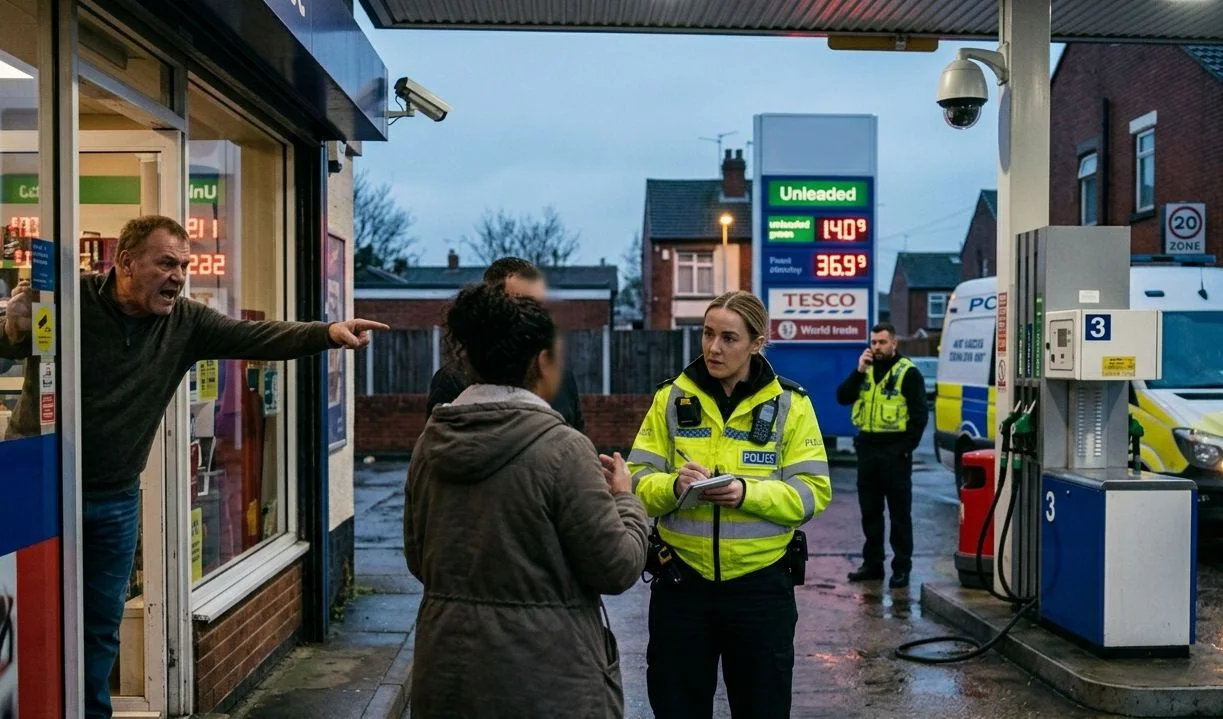
The police response should recognise that difference. A customer who provides accurate details and pays the next day is not the same problem as a vehicle using false plates to fill containers at several sites. Treating both as one low-value category wastes time on the first and misses the pattern in the second.
That is the conclusion the new figures support. Police should not attend every unpaid filling. They should record reports properly, remove genuine mistakes quickly and join the remaining evidence across vehicles, offenders and locations. The present system too often does none of those things well.
The ITV estimate covers the UK. The law, crime-recording rules and policing recommendations below concern England and Wales. Scotland and Northern Ireland have different criminal-law frameworks and should not be folded into an England and Wales policy answer.

£194,000 a day is an estimate, not a crime count
Forecourt Eye compared the five months after 28 February 2026 with the preceding five months. It reported 20% more incidents of fuel taken without payment and a 48% increase in their value. Petrol had reached an average of 160p a litre and diesel 179p by the end of July, according to the figures quoted by ITV.
The difference between the 20% rise in incidents and the 48% rise in value matters. More events were being reported, but each unpaid fill had also become more expensive. The £194,000 headline therefore measures the combined effect of frequency, the amount taken and pump prices. It does not mean offending itself rose by 48%.
There are other limits. Forecourt Eye described the 550 sites as a representative sample, but ITV did not publish the sampling method, geographical spread or confidence interval. Reports made to a recovery company are not the same dataset as crimes recorded by police. The category also includes no-means-of-payment reports. Some will involve dishonesty; others will become an ordinary debt and be paid.
The company’s distinction between “first-time” and repeat offenders needs similar care. In this context, first-time means not previously identified in its system. It is not proof that the person had never offended before.
None of this makes the increase unimportant. A 2023 peer-reviewed study by Aiden Sidebottom, Iain Agar and Justin Kurland examined 36,573 police-recorded incidents across six forces between January 2018 and July 2022. Across the full period, the relationship between price and theft was weak. During the exceptional price spike in 2022, however, higher prices were strongly associated with elevated theft. The current industry figures fit that pattern, although they do not prove that prices caused every additional incident.
Not every unpaid tank is the same offence
In England and Wales, section 3 of the Theft Act 1978 makes it an offence to dishonestly make off without paying when payment on the spot is required or expected, with the intention of avoiding payment permanently. Those final words carry much of the argument. Forgetting to pay, discovering that a bank card has failed or asking the retailer to accept later payment does not automatically establish the offence.
The Crown Prosecution Service guidance explains a further complication. If the retailer agrees to wait for payment, payment on the spot is no longer required. Making off without payment may then not be the correct offence, although fraud may be considered where false details were supplied dishonestly.
This does not allow forces to label every forecourt report a civil dispute. The Home Office Crime Recording Rules in force from April 2026 are unusually clear. A report of making off from a garage forecourt should be recorded under the National Crime Recording Standard, should not be delayed for investigation and “should not be treated as purely a civil matter”. A making-off will usually be enough to record a crime unless credible evidence shows an innocent mistake. Payment before police contact can support cancellation; payment only after police become involved does not necessarily do so.
The correct sequence is therefore record, assess and distinguish. It is not reject, send to civil recovery and assume that criminal intent will be impossible to prove.
The older figures were bad enough without exaggeration
In May 2025, Forecourt Trader reported Freedom of Information data supplied by 33 forces. The returns covered more than 130,000 reported drive-offs since 2020. Across the responding forces, an average of 86% were closed without a suspect being identified. Sussex Police recorded the highest cited rate: 94% of 2,892 cases. Humberside closed 83% of 3,008 in that way, while South Yorkshire closed 91% of 3,483. The accurate national comparison is therefore an 86% average no-suspect closure rate within the forces that responded, not a 99% non-prosecution rate.
Those figures show a poor outcome, but they need precise language. “Closed with no suspect identified” is not the same as “not prosecuted”, and it does not prove that no enquiry took place. Nor does a registration number prove who was driving. Plates may be cloned or stolen, a vehicle may have no current registered keeper and CCTV may show clothing rather than a usable face.
The same investigation illustrates why those limitations cannot become a blanket excuse. Industry data cited alongside it suggested that 13% of cases involved cloned or false plates, or vehicles with no registered keeper. Those are not reasons to abandon the report. They are indicators of preparation, repeat offending or links to other crime.
The data also remain incomplete. Twelve forces did not supply the requested information, recording practices differed and retailers who no longer report to police are absent. The £6.5 million of loss identified by the investigation was therefore a total within the returns, not the national cost of fuel theft.
A number plate is a line of enquiry, not a solved case
The old argument was too simple: clear CCTV plus a number plate should equal an identified offender. Sometimes it will. Often it will not.
The stronger criticism is that these are reasonable lines of enquiry which should be assessed before a case is closed. The College of Policing investigation guidance requires investigators to follow reasonable and relevant lines of enquiry and explain what they did, what they did not do and why. It does not require an endless investigation into every £80 loss. It does require a defensible decision.
Forecourts are useful “islands of enquiry” because they can combine a timed transaction, a vehicle image, CCTV and repeated visits. That does not mean every site has facial recognition or that every private ANPR camera is connected to a national police database. The value comes from joining ordinary evidence well.
Case-by-case screening works against that. Ten separate losses by the same vehicle may each appear too small to allocate. Viewed as a series, they show persistence, intent and a much better prospect of identification. False plates, changes of vehicle, containers being filled, threats to staff and movement between force areas make the case stronger still.
This is where the industry’s private recovery systems have an advantage. They see reports across multiple sites and can identify repetition earlier than a local police queue treating each crime separately. ITV reports that Forecourt Eye is now offering customers access to Facewatch reporting technology, with an option to join its live facial-recognition network. That development may help retailers prevent loss, but it also shows identification moving into a private system because public enforcement is seen as ineffective. Questions about accuracy, proportionality, data protection and redress do not disappear because the police are absent.
Stop asking whether an officer should attend every forecourt
Attendance is the wrong test for most fuel-theft reports. The useful question is whether evidence can be transferred quickly, checked once and linked to other offending.
Forces should require a short, structured digital report. It should distinguish an immediate drive-off from a customer who came to the till, record whether valid contact details were supplied, capture the registration and vehicle description, and allow the retailer to upload the full incident footage before it is overwritten. The report should also flag false or missing plates, containers, aggression, multiple visits and known repetition.
A genuine mistake that is paid promptly can then leave the crime system quickly and transparently. A declared inability to pay with verified details can normally continue through the retailer’s recovery process unless later conduct supplies evidence of dishonesty. Neither needs a response officer by default.
A deliberate drive-off with a usable line of enquiry should receive a basic desktop investigation. That means checking the registration, viewing the supplied footage and searching for linked reports before recording that no suspect can be identified. Where the same vehicle, person or method appears again, the reports should be combined and allocated as a series rather than closed one by one.
Chief constables also need a threshold for escalation. Repetition across sites, false or cloned plates, fuel taken for resale, threats to staff and links to other acquisitive crime should move the case out of the low-value queue. Neighbourhood teams can then use problem-solving at persistently targeted sites, while investigators deal with the offender rather than the individual tank of fuel.
Retailers carry part of the responsibility. Prompt reporting, complete footage and reliable no-means-of-payment records make the distinction possible. At sites or times with repeated losses, pre-authorisation, pay-at-pump or prepayment may be justified. Those controls have costs and can reduce visits to the shop, particularly for independent and rural forecourts, so “design it out” is not a complete police policy. It is still part of a realistic prevention plan.
The test is whether forces can find the pattern
The latest price spike makes fuel theft more expensive and, on the available evidence, more frequent. It does not turn every unpaid filling into organised crime. Nor does the possibility of an innocent mistake justify treating deliberate drive-offs as someone else’s debt collection problem.
The National Police Chiefs’ Council and National Business Crime Centre should agree a common reporting dataset with the forecourt industry. Forces should then audit a sample of no-suspect closures and publish whether the available CCTV was viewed, the vehicle was checked and linked reports were searched. Charge rates alone will not show success; prompt repayment, prevented repeat offences and identified series matter too.
The £194,000 figure will rise or fall with prices, reporting and the method used to extrapolate it. The operational failure is more stable. Police and retailers hold fragments of the same pattern, but too often process them in separate systems as isolated losses. Until those fragments are joined, genuine mistakes will continue to inflate the headline and repeat offenders will continue to hide inside it.
Sources and further reading
- ITV News, “Fuel theft: Nearly £200,000 stolen from UK forecourts daily during Iran war”, 3 August 2026.
- Forecourt Trader, “£6.5m of fuel stolen in drive-offs as up to 94% of offenders escape justice”, 12 May 2025.
- Home Office, Crime Recording Rules for front-line officers and staff, April 2026.
- Theft Act 1978, section 3 and CPS guidance on making off without payment.
- Aiden Sidebottom, Iain Agar and Justin Kurland, “Do increases in the price of fuel increase levels of fuel theft? Evidence from England and Wales”, Crime Science 12, 2023.
- College of Policing, Investigation process.
Discussion questions
- 01
Can your force distinguish genuine no-means-of-payment cases from deliberate drive-offs in its reporting data?
- 02
How often are repeated vehicles or methods linked before individual low-value fuel theft reports are closed?
- 03
What minimum evidence check should occur before a fuel-theft case is recorded as no suspect identified?
Related reading
- Leadership & CultureHenry Nowak Murder: What the Court Found and What the IOPC Is InvestigatingJun 2026
- Influential PeopleAlex Murray and the Society That Asked Policing to Prove What WorksJun 2026
- Influential PeopleThe Society of Evidence-Based Policing: Nurturing the Idea That Every Officer Can Test What WorksJun 2026