Domestic abuse risk grading: what supervisors should challenge about ‘medium’
In brief
How supervisors can test the reasoning behind a medium domestic abuse risk grade, review the safeguarding plan and recognise the limits of DARA.

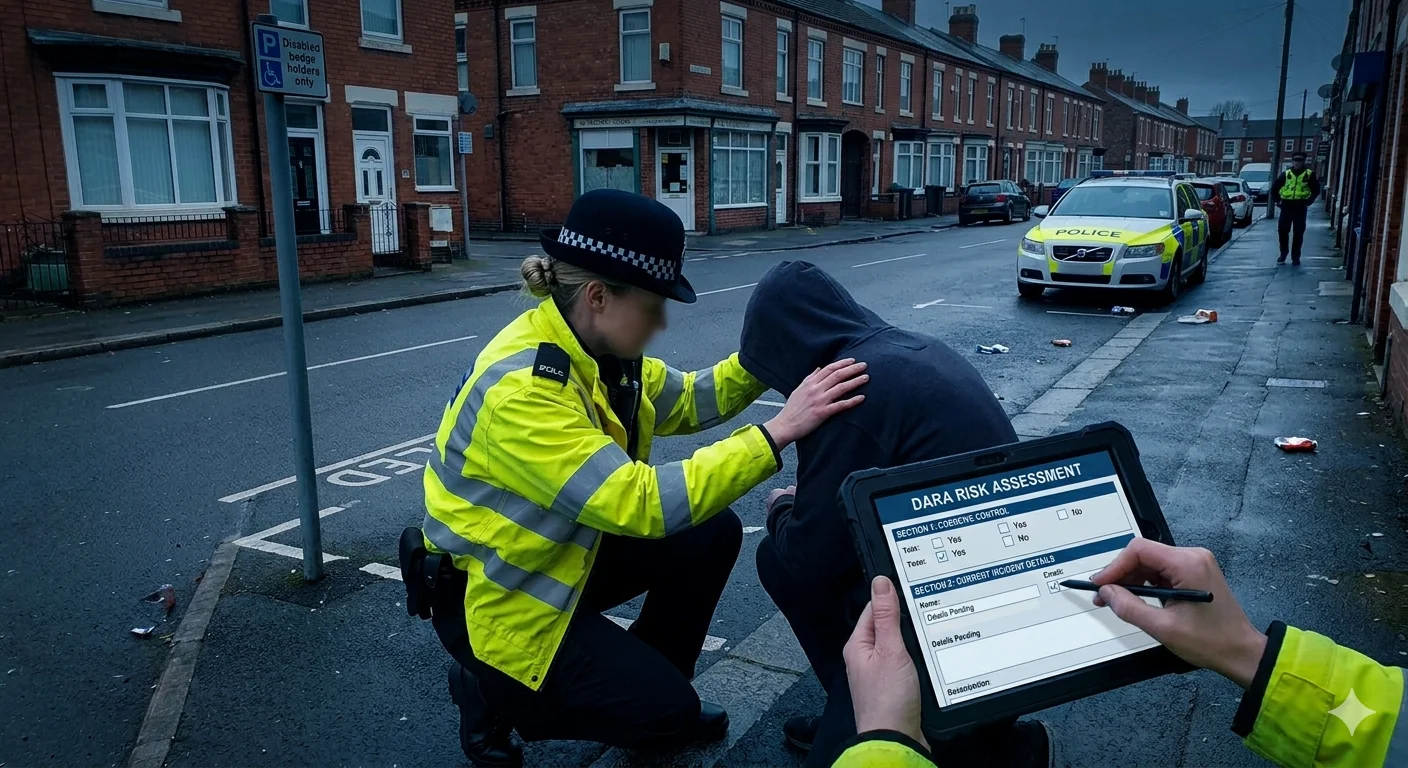
Medium is the easiest domestic abuse risk grade to choose when you are uncertain. That is exactly why it is the grade most at risk of becoming meaningless.
The current College of Policing position is clear that domestic abuse risk assessment is not a mechanical score. Its authorised professional practice describes structured professional judgement: a tool can guide the assessor, but responsibility for the final grade remains with the person making the decision. The same guidance says risk is dynamic and should be reassessed when circumstances change. College of Policing, risks and vulnerabilities, updated 30 March 2026.
That makes the central question more important than the form itself: what does medium actually mean in practice, and what happens when officers use it as the safe option between standard and high?
My argument is that medium should be treated as a real category with a reason behind it, not as a refuge from committing to either end of the scale. The evidence does not support treating any domestic abuse grade as a reliable prediction of what will happen next. It does support using structured judgement consistently, recording why the grade was chosen and reviewing the action that follows from it.
A grade should describe the risk in front of us, not how exposed the decision-maker feels.
Medium becomes useless if it means “I am not sure”
Anyone who has supervised domestic abuse investigations will recognise the practical problem. Standard can feel like an uncomfortable decision because it appears to say that nothing serious is likely to happen. High carries obvious consequences and scrutiny. Medium sits between them and can therefore feel like the least contestable answer.
But a grading scale only works if the categories discriminate. If officers routinely choose medium whenever the evidence is uncertain, the system loses a meaningful middle. A case with identifiable risk factors and an emerging trigger then sits beside a case that was graded medium largely because the assessor did not want to choose standard.
That is not an argument for pushing cases down the scale. It is an argument for making the reasoning visible.
The College’s revised domestic abuse APP, published on 30 March 2026, says officers should initially treat every domestic abuse case as high-risk until it has been assessed. It then describes structured professional judgement as an approach in which a structured tool guides the assessor but does not replace their responsibility. College of Policing, 30 March 2026.
That distinction matters. The assessment tool supplies structure. The officer supplies judgement. Neither can safely substitute for the other.
The tools help, but they do not predict the future cleanly
There is a temptation to solve uncertainty by leaning harder on the tool. The research does not justify that.
A major 2019 study by Emily Turner, Juanjo Medina-Ariza and Gavin Brown examined police domestic abuse risk assessment using data from an unnamed large UK metropolitan police force. It found that DASH had limited predictive accuracy and that most serious-harm revictimisation cases were graded standard or medium rather than high. Turner, Medina-Ariza and Brown, British Journal of Criminology, 2019.
DARA was introduced partly to improve frontline assessment, including the recognition of coercive and controlling behaviour. The College reported that its pilot produced a 38% increase in the proportion of officers reaching the same risk decision as a domestic abuse expert. That is evidence about consistency with an expert comparator, not proof that the grade accurately predicts future serious harm. College of Policing, 26 November 2022.
A new independent study published in Policing: A Journal of Policy and Practice on 14 July 2026 adds useful evidence. Using administrative data from a force that was not part of the original DARA pilot, the researchers found 12-month repeat victimisation in 31% of cases initially graded standard, 44% graded medium and 58% graded high. Those differences are important, but the authors explicitly describe the analysis as exploratory and descriptive: it was not designed to establish predictive accuracy or causality. Policing, 14 July 2026.
The same study also found that the proportion of cases graded high fell after DARA was introduced compared with the preceding DASH period. The authors offer several possible explanations, including improved specificity, changed organisational expectations and training effects. They do not establish which explanation is correct. Policing, 14 July 2026.
That is a useful warning against simple stories. A lower high-risk rate could mean better discrimination. It could also reflect different grading behaviour. The number alone cannot tell us.
The better question is “why this grade?”
If the tool cannot remove uncertainty, supervision has to deal with it directly.
A useful review starts with the evidence rather than the box. What has happened? What pattern is visible? What vulnerabilities are present? What has changed? What is likely to change next? What information is missing? What would make the assessor move the case up or down the scale?
That approach fits the College’s wider National Decision Model. The NDM requires officers to gather information, assess threat and risk, consider powers and policy, identify options, act and review. College of Policing, National Decision Model.
For domestic abuse grading, the practical benefit is that it produces a rationale that can be tested later. “Medium because I was not comfortable with standard” is not a risk assessment. “Medium because these risk indicators are present, the current information does not indicate imminent serious harm, these circumstances would materially increase the risk, and this is the safeguarding plan” is a decision another officer can understand and review.
The exact wording will vary by force process and the facts of the case. The point is that the reasoning should survive the handover.
A risk grade is not the safeguarding plan
The other failure mode is to treat the grade as though it decides the response automatically.
The College’s current domestic abuse APP says the first responder is likely to be responsible for the initial investigation, risk identification and immediate safety planning until the case is formally handed over. It also says risk should be reassessed when circumstances change. College of Policing, updated 30 March 2026.
That means two cases with the same headline grade can still need different action. A medium-risk victim facing an imminent separation, a forthcoming court date, pregnancy, escalating stalking or a perpetrator’s release from custody may require a very different plan from another medium case with a different pattern of risk. The grade is a summary. It is not the investigation and it is not the safeguarding response.
This is also why simply increasing the number of high grades is not a defensible measure of improved practice. If high becomes the new medium, the same information problem reappears one step up the scale.
What supervisors should do differently
The operational change is small enough to be realistic.
Supervisors should stop asking only, “Do I agree with medium?” and instead ask three linked questions:
- What evidence makes this standard, medium or high?
- What change in circumstances would alter that judgement?
- Does the safeguarding and investigation plan address the risks actually identified?
Where a force audits domestic abuse grading, it should therefore examine the rationale as well as the distribution of grades. A force with fewer high-risk assessments is not necessarily under-grading; a force with more is not necessarily safer. The 2026 DARA study is a useful illustration of why those distributions need interpretation rather than praise or criticism on sight. Policing, 14 July 2026.
The same principle applies to training. The objective should not be to teach officers which box is safest. It should be to improve agreement about the evidence that separates the boxes, while preserving professional judgement for cases that do not fit neatly.
Medium should be a decision, not a compromise
DARA is an improvement attempt, not an oracle. The College’s own framework places professional judgement at the centre of the decision, and the independent evidence still gives good reason to be cautious about predictive claims.
The practical implication is straightforward. Medium should mean that the assessor has identified a genuine level of risk between standard and high and can explain why. It should not mean “I could not justify high but did not want to write standard”.
For supervisors and force leaders, the test is therefore not whether enough cases are graded high or whether standard is being used more often. It is whether the reasoning is consistent, the assessment changes when the facts change, and the safeguarding response follows the risk that has actually been identified.
That is a harder standard than checking a box. It is also much closer to what structured professional judgement is supposed to achieve.
Sources and further reading
- College of Policing — Domestic abuse: risks and vulnerabilities, updated 30 March 2026
- College of Policing — Police better equipped to spot controlling behaviour, 26 November 2022
- Turner, Medina-Ariza and Brown — “Dashing Hopes? The Predictive Accuracy of Domestic Abuse Risk Assessment by Police”, 2019
- “Reassessing the evidence base: a critical appraisal of Domestic Abuse Risk Assessment in practice”, Policing, 14 July 2026
- College of Policing — National Decision Model
Discussion questions
- 01
When you review a domestic abuse risk grade, what evidence would make you move it from medium to standard or high?
- 02
Does your force use medium as a genuine risk category, or has it become the safest-looking default?
- 03
Should supervisors record why they agree with a risk grade rather than simply confirming it?