Lawrence Sherman and the Invention of Evidence-Based Policing
In 1981 Lawrence Sherman ran a domestic violence call as a scientific experiment, and policing was never quite the same. A profile of the American criminologist who argued that the police should be tested like medicine — and who taught the officers, Alex Murray among them, who carried the idea into British policing.


In 1981 a criminologist talked the Minneapolis police into running their domestic violence calls as a scientific experiment. When officers reached a misdemeanour assault with both parties still on the scene, a pad of colour-coded report forms told them, at random, which of three responses to use: arrest the suspect, send one party away for the night, or give advice and leave. The aim was to find out, rather than guess, which response did most to stop the violence happening again.
The man behind the pad of random assignments was Lawrence W. Sherman. OJP later described the Minneapolis Domestic Violence Experiment as the first controlled test of the effects of arrest on recidivism in misdemeanor domestic violence; it was a randomised field experiment, not a trial of arrest for every kind of domestic abuse. Readers of the profile of Alex Murray will know Sherman as the Cambridge academic whose evidence-based policing work influenced practitioner-researchers in Britain and beyond.
The police should be tested like medicine.
The making of an experimentalist
Sherman was born in 1949 and educated on both sides of the Atlantic. He took a degree in political science at Denison University in Ohio, a master’s at the University of Chicago, a diploma in criminology at Cambridge in 1973, and finally a doctorate in sociology at Yale in 1976. The Cambridge year mattered: it gave an American sociologist a lasting tie to the English institution he would eventually lead, and to a tradition of careful, quantitative criminology.
His first home as a researcher was the Police Foundation in Washington, where he became director of research. The Foundation had already run the Kansas City Preventive Patrol Experiment in the early 1970s, which found that varying the amount of routine patrol made no measurable difference to crime or to public fear. That result — that one of policing’s central activities might simply not work the way everyone assumed — seems to have set the course of Sherman’s career. If patrol could be tested and found wanting, so could anything. The question was whether the police would let it be tested.
The experiment that changed the law, and then complicated it
In Minneapolis they let him. The study involved 330 eligible misdemeanor domestic-assault cases where both victim and suspect were present when police arrived. In the original follow-up, official repeat violence was detected in roughly 10% of arrested suspects and roughly 20% of suspects who were not arrested. The result travelled quickly: a 1989 policy-impact study found that more than one-third of responding police departments in 117 US cities said the experiment had influenced their policy. By late 1991, 15 states and the District of Columbia had mandatory-arrest statutes for qualifying misdemeanor domestic violence. That policy movement was faster and broader than the evidence base then justified.
What happened next is more complicated than a neat reversal. Replication experiments produced deterrent effects in some analyses, no clear effect in others and escalation effects in others. The Milwaukee experiment, which included 1,200 cases, found no overall long-term deterrent effect and found higher recidivism after arrest among suspects with a low ‘stake in conformity’, including unemployed and unmarried suspects. A later NIJ multisite re-analysis of 4,032 incidents across five jurisdictions, however, found a modest average deterrent effect, stronger in victim-interview measures than official police records.
That mixed history is the more useful evidence-based policing lesson. Replication can reveal effects that vary by population, outcome measure and follow-up period; later synthesis can also change the interpretation of the replications themselves. The method works when it makes a confident policy claim more conditional, not only when it produces a dramatic reversal.
Crime has an address
Sherman’s second great contribution was to ask not what works but where. Analysing a year of calls to the Minneapolis police in the late 1980s with Patrick Gartin and Michael Buerger, he found that crime was not spread evenly across a city at all. It clustered, and the clustering was extreme.
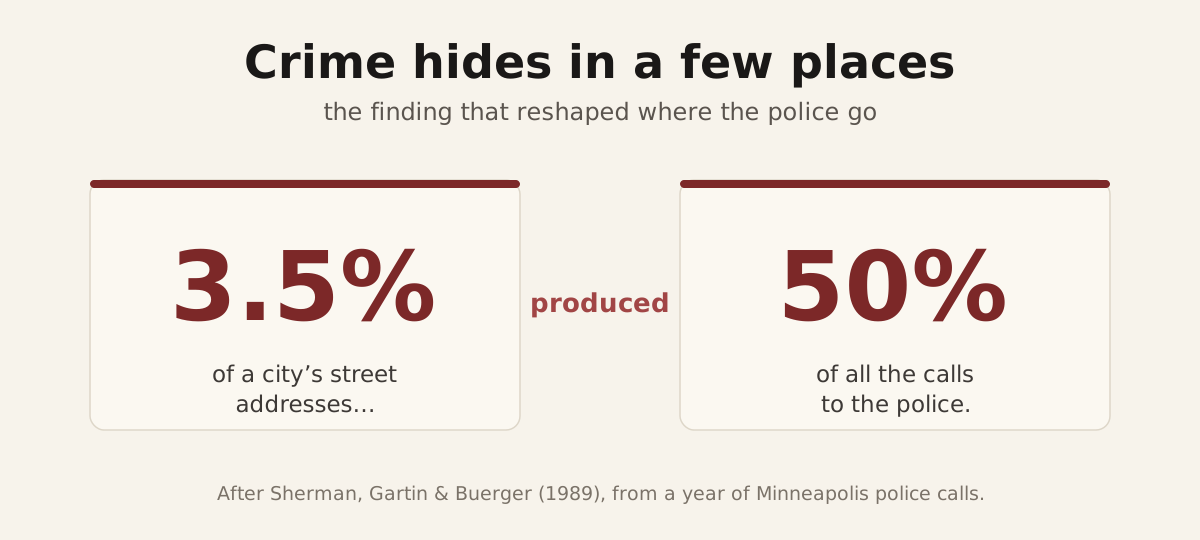
Across 323,979 calls to police and roughly 115,000 addresses and intersections, the 1989 study found that 50% of calls went to about 3% of places. That is a Minneapolis result from one year, not a universal constant, but subsequent research has repeatedly found substantial spatial concentration of crime and demand. Sherman and David Weisburd then tested directed patrol in Minneapolis hot spots using a randomised controlled design and reported reductions in observed disorder and calls at treatment places. The important move was from describing concentration to testing what police should do about it.

Naming the idea
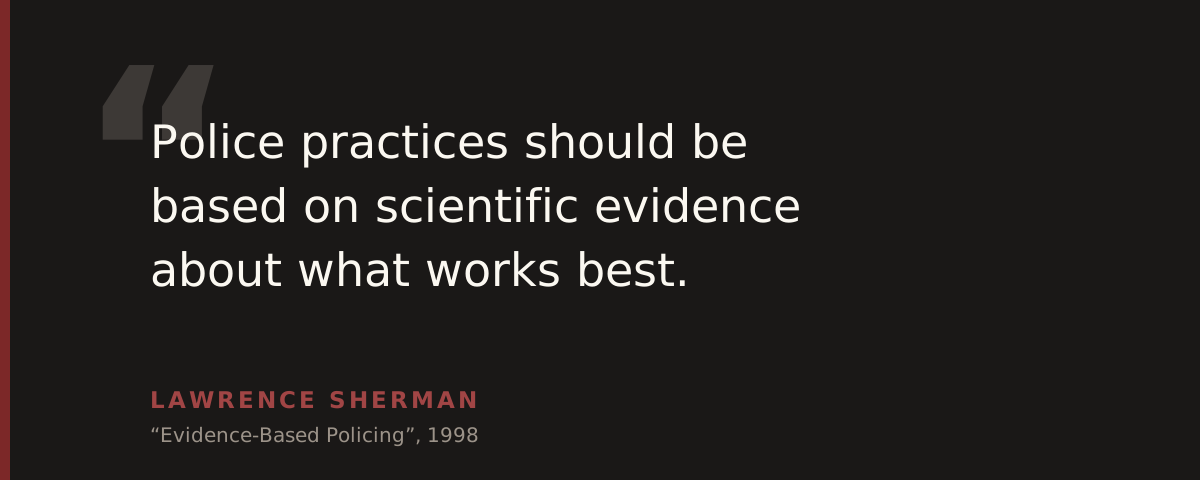
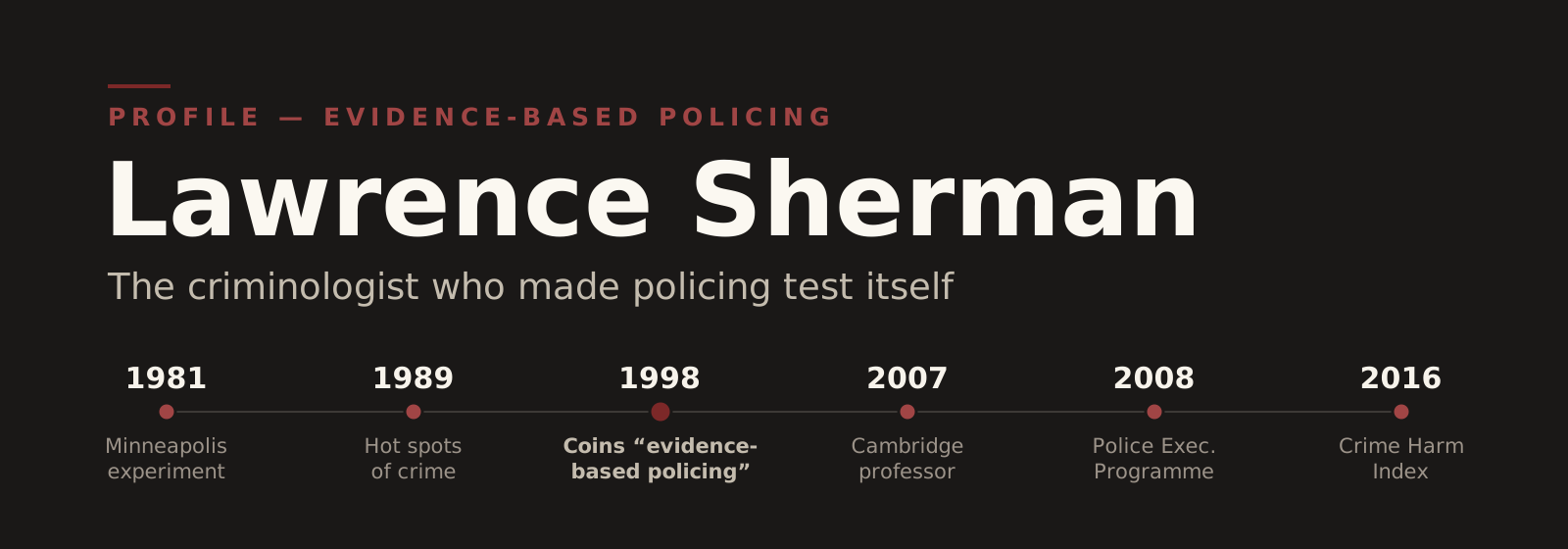
By 1998 Sherman had a body of experiments and a conviction about what they meant, and he gave the conviction a name. In a lecture for the Police Foundation, published as a short paper that has been cited ever since, he set out the concept of evidence-based policing. The phrase was a deliberate echo of evidence-based medicine, then transforming clinical practice, and the argument was the same: that practitioners should be guided by the best available research about what actually works, not by custom, intuition or rank.
He later sharpened the framework into a slogan that British readers may recognise from the Murray profile. For most of its history, Sherman argued, policing had run on three Rs — random patrol, rapid response and reactive investigation — none of which had much evidence behind it. In their place he proposed the Triple-T: targeting the few places, times and people that cause most harm; testing responses through controlled trials; and tracking whether the effect lasts. The framework is set out in full, with a diagram, in the Murray piece; the point worth making here is whose framework it was. Murray built the institution. Sherman built the idea it was founded to spread.
Cambridge, and a school of officers
Sherman’s American career was substantial in its own right. He chaired the criminology department at the University of Maryland, then moved to the University of Pennsylvania, where in 2003 he founded the first separate department of criminology in the Ivy League. But his lasting influence on British policing runs through Cambridge, where he returned in 2007 as Wolfson Professor of Criminology, later directing the Institute of Criminology and the Jerry Lee Centre of Experimental Criminology.
The vehicle was the Police Executive Programme, the part-time Cambridge master’s for serving senior officers, which from 2008 Sherman built around evidence-based policing. A generation of British and international police leaders passed through it, writing their own small experiments as dissertations and carrying the method home to their forces. Alex Murray’s 2008 thesis on police legitimacy in Muslim communities was one of them; the two later co-authored a peer-reviewed paper from it. The Society of Evidence-Based Policing that Murray founded in 2010 elected Sherman its honorary president. Much of what looks, from the outside, like a British movement was in practice a Cambridge seminar room spreading outward.
Two further pieces of work from this period are worth naming. With Heather Strang and colleagues, Sherman developed and tested face-to-face restorative-justice conferencing. A Campbell review later synthesised ten eligible randomised trials involving 1,880 consenting accused or convicted offenders and their consenting victims; the evidence applies to that specific conference model and consenting populations, not everything labelled ‘restorative justice’. In 2016, with Peter and Eleanor Neyroud, Sherman also proposed the Cambridge Crime Harm Index, weighting offences using sentencing guidance rather than counting every recorded crime as equivalent.
The honours, and the argument they recognise
The recognition followed. Sherman received the American Society of Criminology’s Edwin Sutherland Award, its highest honour, in 1999, and served as the Society’s president in 2001. Germany’s criminological societies gave him the Beccaria Gold Medal in 2009; the Royal Society of Arts awarded him its Benjamin Franklin Medal in 2011. With the philanthropist Jerry Lee he helped create the Stockholm Prize in Criminology, first awarded in 2006, and has co-chaired its jury since. One ranking of citation influence placed him as the most influential criminologist of the 2010s. The titles matter less than the through-line they trace: a single argument, pressed for half a century, that the police should find out whether what they do works.
What the experiments cannot settle
It would flatter the field to pretend the argument is won, or that it answers every objection. It does not, and the strongest criticisms deserve stating plainly. Experiments do not always replicate — the domestic violence saga is proof of that from inside the discipline. A method built to ask “what works?” can quietly narrow the question to “what reduces recorded crime?”, and crowd out harder questions about what is just, or lawful, or fair to the policed. Hot-spots policing, in particular, concentrates police attention on a small number of places, and the people who live in those places are not evenly distributed across a society; done badly, targeting the map can mean targeting the same communities again and again, at a cost to trust that no crime count captures.
Sherman’s answer was never that evidence settles questions of value. It is that you cannot have a sensible argument about values without first knowing what your choices actually do. The Minneapolis reversal is, in the end, his best case. A profession that arrests because arresting feels like justice will never discover that its instinct is sometimes wrong. A profession that runs the experiment can. That capacity to be corrected by its own findings is not a weakness of evidence-based policing. It is the whole of what Sherman was offering.
The detective who built the Society learned the method from the professor who built the experiment. Between them they moved British policing, slowly and incompletely, towards a harder and more truthful standard than the one it inherited: not “this is how we have always done it”, but “show me that it works”.
Sources and further reading
- Lawrence W. Sherman, “Evidence-Based Policing”, Ideas in American Policing, Police Foundation, 1998.
- Lawrence W. Sherman and Richard A. Berk, “The Minneapolis Domestic Violence Experiment”, Police Foundation, 1984.
- Lawrence W. Sherman, Patrick R. Gartin and Michael E. Buerger, “Hot Spots of Predatory Crime: Routine Activities and the Criminology of Place”, Criminology, 1989.
- Lawrence W. Sherman and David Weisburd, “General Deterrent Effects of Police Patrol in Crime Hot Spots: A Randomized, Controlled Trial”, 1995.
- Lawrence Sherman, Peter Neyroud and Eleanor Neyroud, “The Cambridge Crime Harm Index: Measuring Total Harm from Crime Based on Sentencing Guidelines”, Policing, 2016.
- University of Cambridge, MSt in Applied Criminology and Police Management (Police Executive Programme).
- Cambridge Centre for Evidence-Based Policing, Professor Lawrence W. Sherman.
- Wikipedia, Lawrence W. Sherman, Evidence-based policing and Minneapolis Domestic Violence Experiment.
Related reading
- Influential PeopleAlex Murray and the Society That Asked Policing to Prove What WorksJun 2026
- Influential PeopleThe Society of Evidence-Based Policing: Nurturing the Idea That Every Officer Can Test What WorksJun 2026
- Evidence & PracticeAI in policing: what leaders should check before approving a toolJun 2026