Police complaints, the IOPC and local forces: who does what?
In brief
What is the IOPC? How do you complain about the police or check your local force? A plain-English guide to policing bodies and their latest verified reports.


An inspection report, a police misconduct investigation and a staff survey answer different questions. Knowing who produced a report is the first step towards understanding what it tells us about policing.
The names are easy to confuse. HMICFRS inspects services. The IOPC oversees the police complaints system. Police and crime commissioners set local priorities and hold chief constables to account. The Police Federation represents officers. Each has a useful perspective, but each has a different job.
This guide covers the main bodies relevant to policing in England and Wales. Scotland and Northern Ireland have different arrangements. The reports below were checked on 14 September 2026. Each entry identifies the edition or reporting period; a recently uploaded report can still describe events from an earlier year. For bodies publishing many different series, the selection is the most recent relevant report verified for this guide, rather than a claim that it is their newest document of any kind.
Who should I contact? Start with your question
- I want to complain about the police: start with the complaints route below.
- I want to check my local force: read how to use its inspection report.
- I want to understand local priorities and spending: find what the commissioner does.
- I am unhappy with a complaint outcome: check the review route and deadline.
| Your question | Where to start | What to look for |
|---|---|---|
| How well is my force serving the public? | HMICFRS | The latest force inspection, its findings and required improvements |
| Where do I make a complaint about the police? | Usually the force concerned | Its complaints page; the IOPC form also forwards complaints to the relevant force |
| Who investigates the most serious conduct concerns? | IOPC | Investigation findings and learning reports |
| What are the local priorities and where is the money going? | Police and crime commissioner | Police and crime plan, annual report and budget |
| Who challenges the commissioner? | Police and crime panel | Meeting papers, questions, recommendations and the PCC’s replies |
| What are officers saying about pay and working conditions? | Police Federation | Survey results and the methods behind them |
| What is happening to workforce wellbeing? | Oscar Kilo | National and force-level wellbeing findings |
| What are police chiefs agreeing nationally? | National Police Chiefs’ Council | Strategies, operational coordination and leadership responses |
| What standards and research should inform practice? | College of Policing | Professional guidance, research summaries and evaluations |
The sections below explain these roles and link to the original publications. The table is a guide to choosing a source; it is not a hierarchy of organisations or an instruction to send every complaint to a national body.
How do I complain about the police?
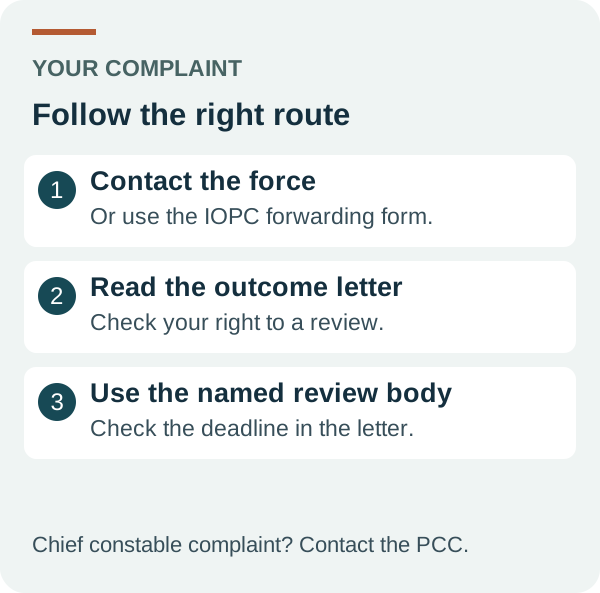
Usually, contact the police force concerned through its complaints page. You can also use the IOPC complaints form. That form sends your complaint to the relevant force or organisation; it does not start an independent IOPC investigation. A complaint about a chief constable goes to the relevant police and crime commissioner.
Have the date, place and any incident reference ready. Explain what happened and what you would like to happen next. The form asks about witnesses and allows you to request adjustments, such as larger print. Keep a copy of what you send. IOPC: submit a complaint.
What happens after I complain?
The force considers how to handle the complaint. Many complaints are resolved without a formal investigation. Possible responses include an explanation, an apology, learning for staff or a change in procedure. Some require investigation. The IOPC investigates the most serious matters, including deaths or serious injuries following police contact. IOPC guide to the complaints process.
What if I am unhappy with the outcome of my complaint?
Read the outcome letter first. It should explain whether you have a right of review and which body handles it. Depending on the case, that may be the IOPC or the relevant local policing body. Do not assume every review belongs with the IOPC.
Where the IOPC is the correct review body, its guidance gives 28 calendar days, starting the day after the date on the outcome letter, to apply. Check the letter promptly; exceptional circumstances may allow a late application. A review examines the handling or outcome of your complaint. It is not automatically a fresh investigation. IOPC: reviews and appeals.
Can the IOPC make the police reopen a criminal investigation?
The IOPC says it cannot direct the police to reinvestigate a criminal allegation. You can complain about officers’ or staff members’ conduct during an investigation, but that does not itself reopen the criminal case. IOPC guide to the complaints process.
How good is my local police force, and what is HMICFRS?
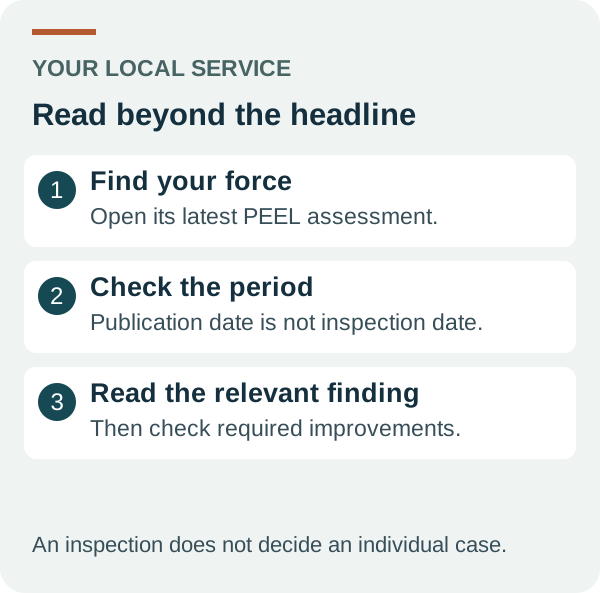
His Majesty’s Inspectorate of Constabulary and Fire & Rescue Services, usually shortened to HMICFRS, independently inspects policing and fire and rescue services. Its PEEL programme assesses police effectiveness, efficiency and legitimacy: how well a force works, how it uses resources and how it treats people. Its guide to PEEL assessments explains the process and provides a route to individual force reports.
How do I find and read my force’s report?
Start with the HMICFRS PEEL assessments guide and follow the force-report links. Select your force, check the inspection period, then read the findings for the service that matters to you. A finding about investigating crime answers a different question from one about treating people fairly. Look for required improvements and any later update. An inspection is a dated assessment; it cannot settle what happened in your individual case. For help interpreting the figures, see how to read police statistics.
What does the latest national report say?
The latest national overview is State of Policing 2025–26, published on 8 September 2026. It brings together inspection findings and the chief inspector’s assessment of the service. It describes continuing weaknesses in investigations and protecting vulnerable people, alongside areas of progress.
One finding shows why the detail matters. Of the 13 forces assessed for investigating crime in the new 2025–27 PEEL cycle at the report’s cut-off, four were adequate, seven required improvement and two were inadequate. None received a good or outstanding grade. Those figures describe the 13 assessed forces, not all 43 territorial forces in England and Wales. State of Policing 2025–26, pages 24–26.
In plain language, the report asks whether forces are delivering a good enough service and where they need to improve. For a local question, read your force’s latest inspection as well as the national overview. Check the inspection period: a new report does not necessarily describe what happened last week.
What is the IOPC, and what does it investigate?
The Independent Office for Police Conduct oversees the police complaints system in England and Wales and investigates the most serious matters involving police conduct. It also sets standards and handles certain reviews. Most complaints are dealt with by police forces themselves. The IOPC’s explanation of what it does sets out those boundaries.
What do the IOPC’s reports tell me?
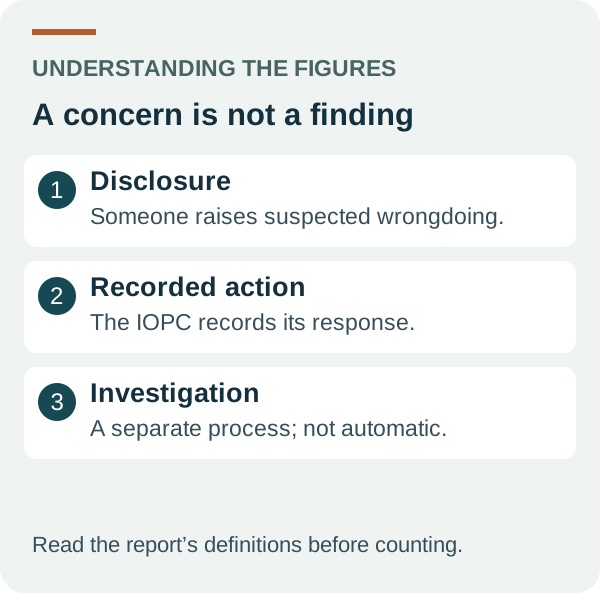
A recent publication is Public Interest Disclosures 2025/2026, published on 8 September 2026. This short report concerns qualifying disclosures of suspected wrongdoing made to the IOPC under whistleblowing arrangements. It is a different series from ordinary public complaints statistics.
The report records 122 disclosures, compared with 93 in 2024/25. It records action on all 122, including seeking consent to pass 42 to the relevant force and referring 27 to its intelligence unit. None led to an independent investigation by the IOPC. These are reports of possible wrongdoing; the totals do not establish 122 proven incidents of misconduct. Nor does a recorded action necessarily mean an investigation was opened. IOPC disclosure report, 2025/26.
The practical reading is: how many concerns reached this particular route, and what happened next? It cannot tell us the total amount of wrongdoing in policing. For wider questions, the IOPC publications library also carries investigation reports, complaints data and learning material.
What does a police and crime commissioner do?
A police and crime commissioner, or PCC, is elected to hold the chief constable to account and set local policing priorities and the budget. The chief constable retains responsibility for operational policing. Some areas have mayoral arrangements instead of a separate PCC. The government’s PCC guide explains the role and helps readers find their local office.
Where can I find the plan, budget and annual report?
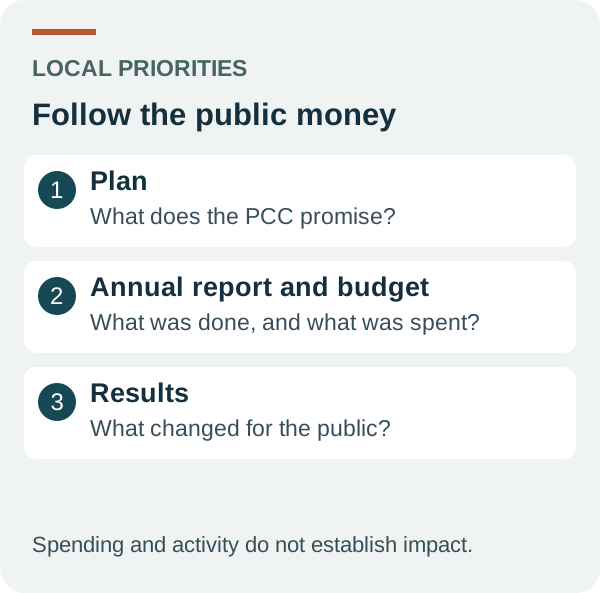
A police and crime plan sets out what the commissioner intends to achieve. An annual report explains what the commissioner says has been done. Budget papers show the resources allocated. Read all three together when judging whether promises have been delivered.
For a current local example, Sussex’s Annual Report and Financial Outturn Report 2025/26 went to the police and crime panel on 2 July 2026. It covers 1 April 2025 to 31 March 2026 and reports against the local police and crime plan. The meeting pack contains the annual report from page 23.
In simple terms, it is the commissioner’s account of priorities, delivery and spending over that year. The financial outturn describes how the year’s spending ended up; the figures presented at this stage should not be confused with completed audited accounts. Reported activity also needs an outcome measure. Funding a service establishes that money was committed; showing whether victims received better support requires evidence about their experience and results.
Sussex is an example, not a national finding. Use the same documents from your own PCC’s office for your force area.
Who holds the police and crime commissioner to account?
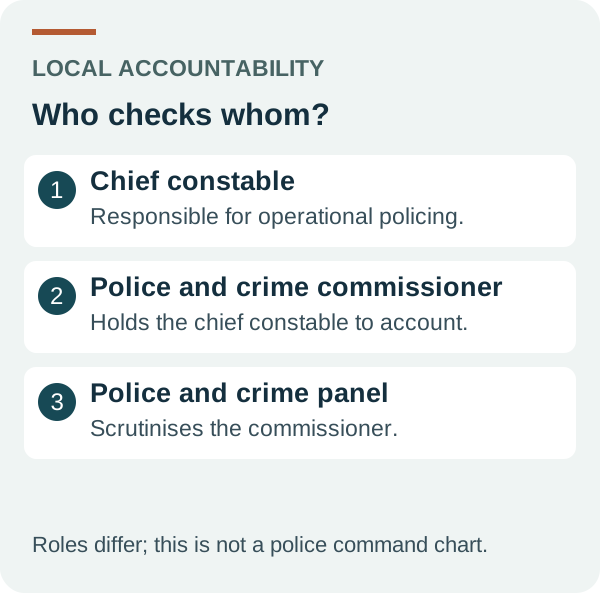
A police and crime panel scrutinises the commissioner. It gives readers somewhere to see questions put to the PCC, recommendations and responses. The Sussex panel’s website describes its role as supporting and scrutinising the Sussex commissioner.
Its letter following scrutiny of the 2025/26 annual report, dated 3 July 2026, makes a useful distinction. Members said the report provided information about resources and activity but less detail about the outcomes achieved. They also asked for clearer, more accessible presentation.
Put simply: what difference did the work make? The panel asked about subjects including violence against women and girls, rural crime and perpetrator programmes. Its letter records questions and requests for better evidence; it does not establish that each programme succeeded or failed.
That is why the scrutiny papers belong beside the annual report. The 2026 meeting record lets readers follow the discussion and look for subsequent replies.
What is the Police Federation, and who does it represent?
The Police Federation of England and Wales represents officers from constable to chief inspector on matters including pay, conditions and welfare. Its website carries national and local branch material. For a public complaint about police conduct, use the complaints route above. The Federation represents officers; its reports should be read with that purpose in mind.
The latest full national report linked from its Pay and Morale Survey page when checked was the 2024 survey, report reference R001/2025. The reporting year matters; this should not be presented as a 2026 survey.
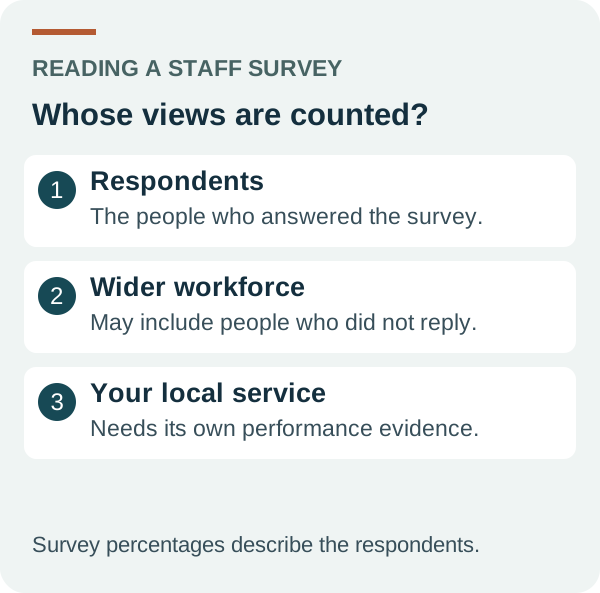
In the 2024 Pay and Morale Survey report, 63% of respondents said their workload was too high and 86% said there were insufficient officers in their team or unit. In everyday terms, many respondents felt they had more work than their staffing could comfortably support.
These are the views of people who answered. They should not automatically be treated as percentages of every serving officer. Differences between participants and non-participants can affect a voluntary survey. The findings identify concerns worth examining alongside staffing, demand and inspection evidence; they cannot by themselves prove what caused a particular service failure.
What is Oscar Kilo, and how are police staff feeling?
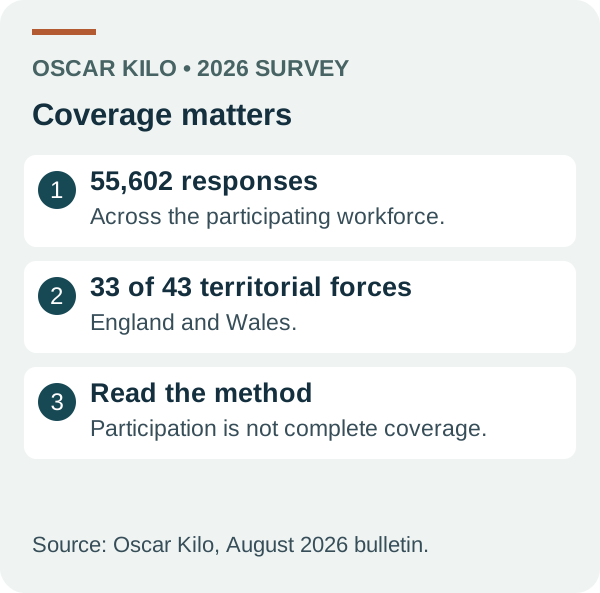
Oscar Kilo is the National Police Wellbeing Service. Its 2026 National Workforce and Wellbeing Survey results, published on 10 August 2026, provide a broader workforce view than an officer-only pay survey.
The service reported 55,602 responses from officers, police community support officers, staff, special constables and volunteers across 33 of the 43 territorial forces in England and Wales. Among respondents, 56% reported regular physical exhaustion and 45% reported regularly feeling burnt out. The same release reported strengths, including 89% feeling they had the skills and experience for their work. Oscar Kilo’s August 2026 results bulletin.
The plain-English message is that commitment and capability can coexist with exhaustion. The figures describe respondents’ experiences, not clinical diagnoses or proof that one workplace policy caused those experiences. Participation also differs from complete workforce coverage.
Use the national wellbeing survey resource page to find the report and check its method before making comparisons with earlier years or a local force.
What is the NPCC, and does it run my local force?
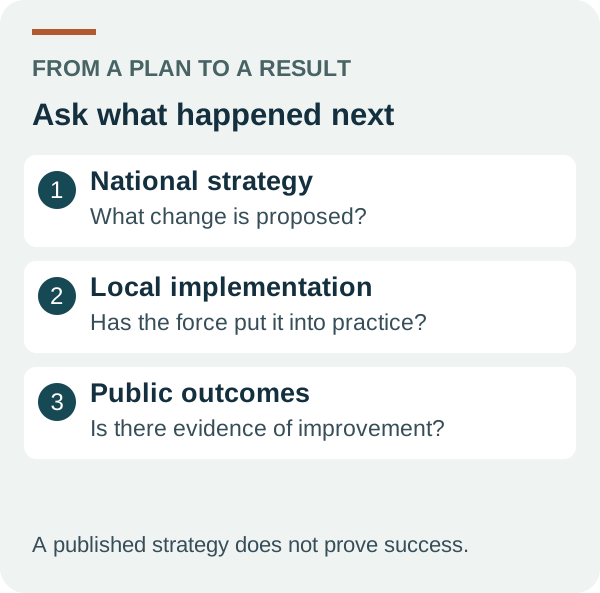
The National Police Chiefs’ Council, or NPCC, brings police chiefs together to coordinate national work. It is a national coordination body; your local force has its own chief constable. Its publications library includes strategies and national approaches across different areas of policing.
Its response to State of Policing, published on 8 September 2026, emphasised the workforce pressures behind the inspection findings and the opportunity presented by reform. In plain language, it sets out the leadership response to the inspector’s assessment.
This is commentary from police leadership, rather than another independent inspection. It is useful for understanding what chiefs believe needs to change. Whether proposed changes subsequently work needs separate evidence about implementation and results.
Read a strategy for its commitments, intended outcomes and responsibilities. A document announcing a national approach does not establish that every force has implemented it or that it has already improved policing.
What does the College of Policing do?
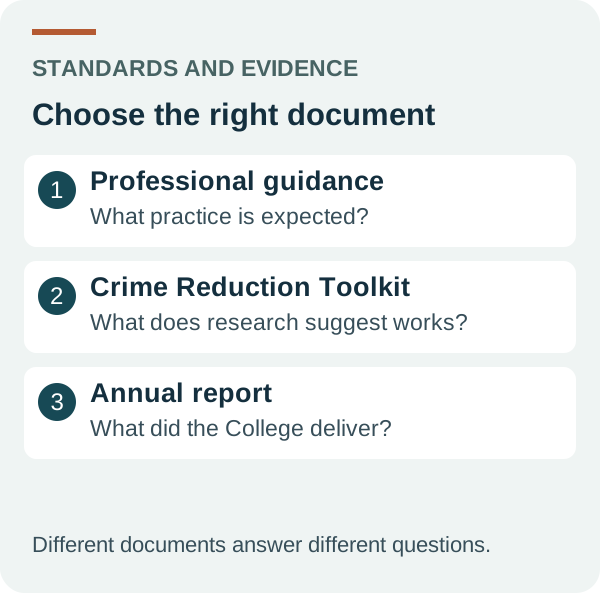
The College of Policing is the professional body for policing in England and Wales. It develops professional standards and supports learning and improvement. Its annual report for the year ended 31 March 2025, pages 6 and 10 explains its role and reports delivery against its business plan.
The latest annual report listed when checked covers 2024/25; GOV.UK published it on 9 February 2026. The publication page links the performance report, accountability information and accounts.
The College reports completing 47 of 81 planned deliverables during the year; some remaining work was scheduled for later years. That describes programme delivery, rather than independently demonstrating better outcomes for the public. The accounts also received a disclaimed audit opinion: the auditor could not express an overall opinion. The report explains the continuing effect of weaknesses in the preceding year’s accounts. College annual report, pages 10 and 116–117.
For an example of how research informs everyday encounters, see our guide to fair treatment and procedural justice.
For a question about whether a policing tactic works, start with the Crime Reduction Toolkit. It summarises research on interventions. Check the individual entry’s evidence and setting before applying it locally. The annual reports index serves the different purpose of explaining the College’s own work and finances.
Read the reports together, without making them say the same thing
The Sussex example gives a practical starting point. Read the annual report for the commissioner’s account, then the panel’s letter for the questions that account leaves open. Add the force inspection when assessing the service itself. Each source contributes something different.
For a workforce question, the Federation and Oscar Kilo surveys can identify reported pressures. Inspection findings and local demand figures can help test whether those pressures are reflected in service delivery. Agreement between sources strengthens the reason to investigate; it does not automatically establish a cause.
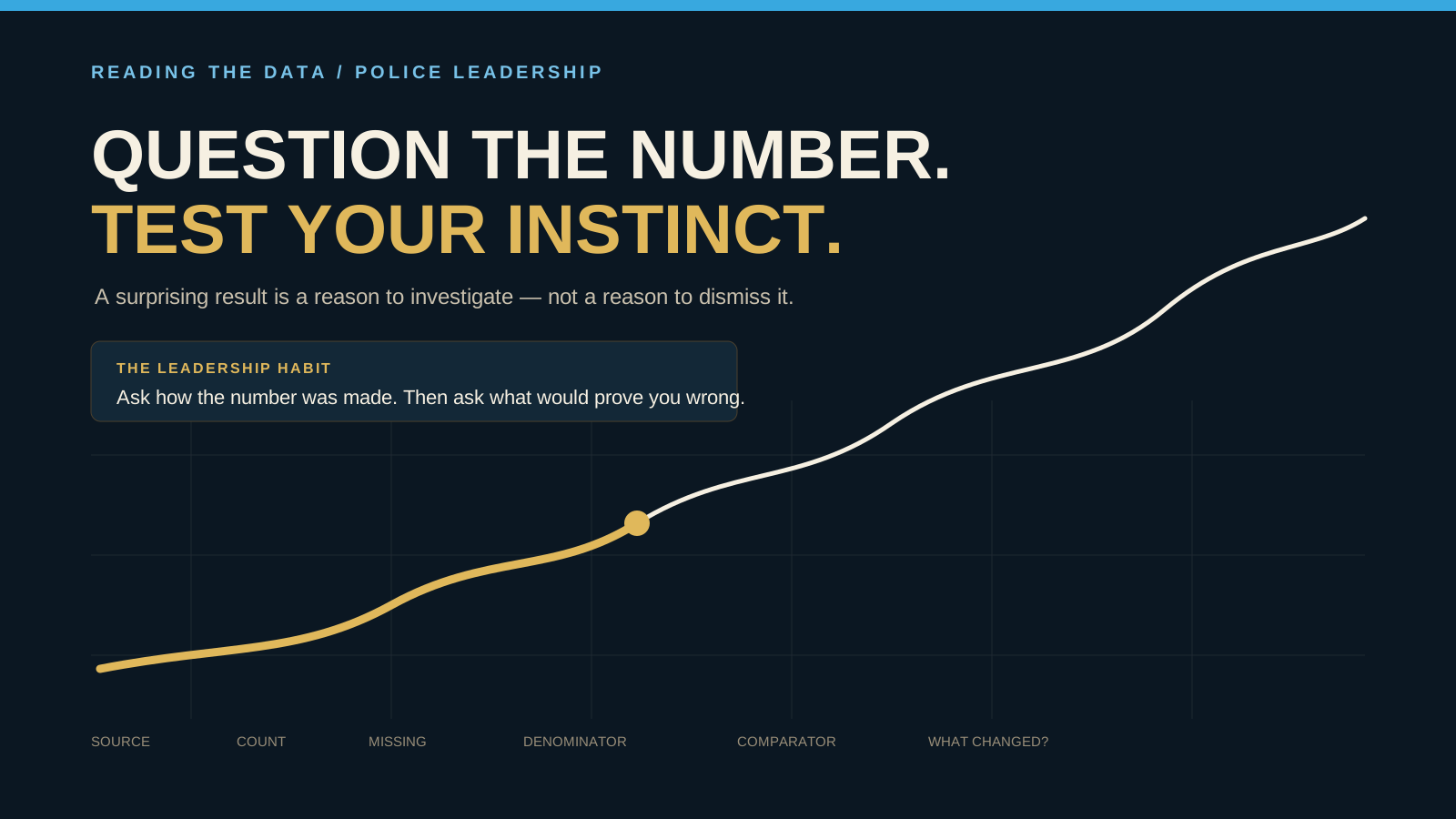
Before repeating a headline figure, check who produced it, the period it covers, who or what was counted, and what it actually measures. An investigation finding, a survey response and a spending total are all evidence. The useful question is what each is evidence of.
For more on evaluating claims, see Reading the Data. For the separate role of a practitioner research network, see The Society of Evidence Based Policing.
For the wider reform programme, see What is Police Reform and will it make a difference?, covering the 2026 proposals and lessons from Scotland.
The next useful document is often the one that asks whether the promised difference actually happened.
Discussion questions
- 01
Which body can help with the question you have about policing?
- 02
Does your local force’s inspection explain the service you experienced?
- 03
What would show that a promised improvement has happened?