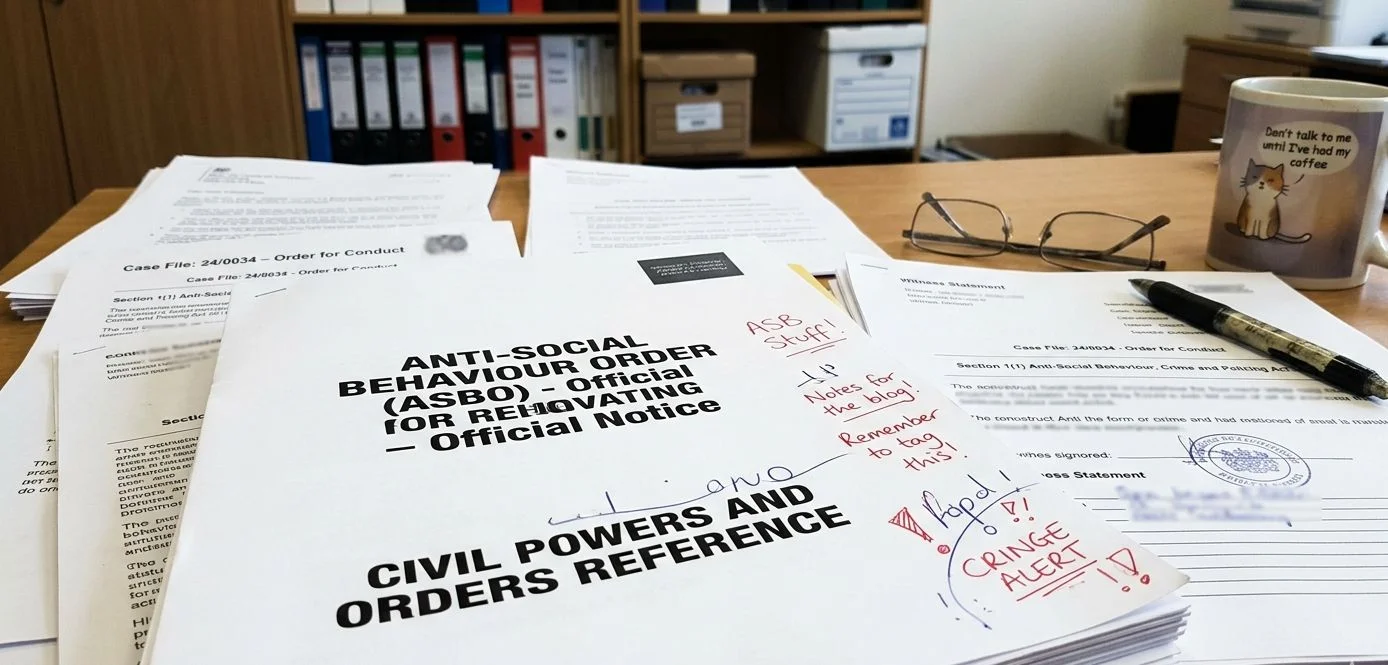

ASB powers are changing. Get the response ready.
A police leader’s guide to Respect Orders and ASB powers in England and Wales, with four free workflow posters and a team briefing pack.
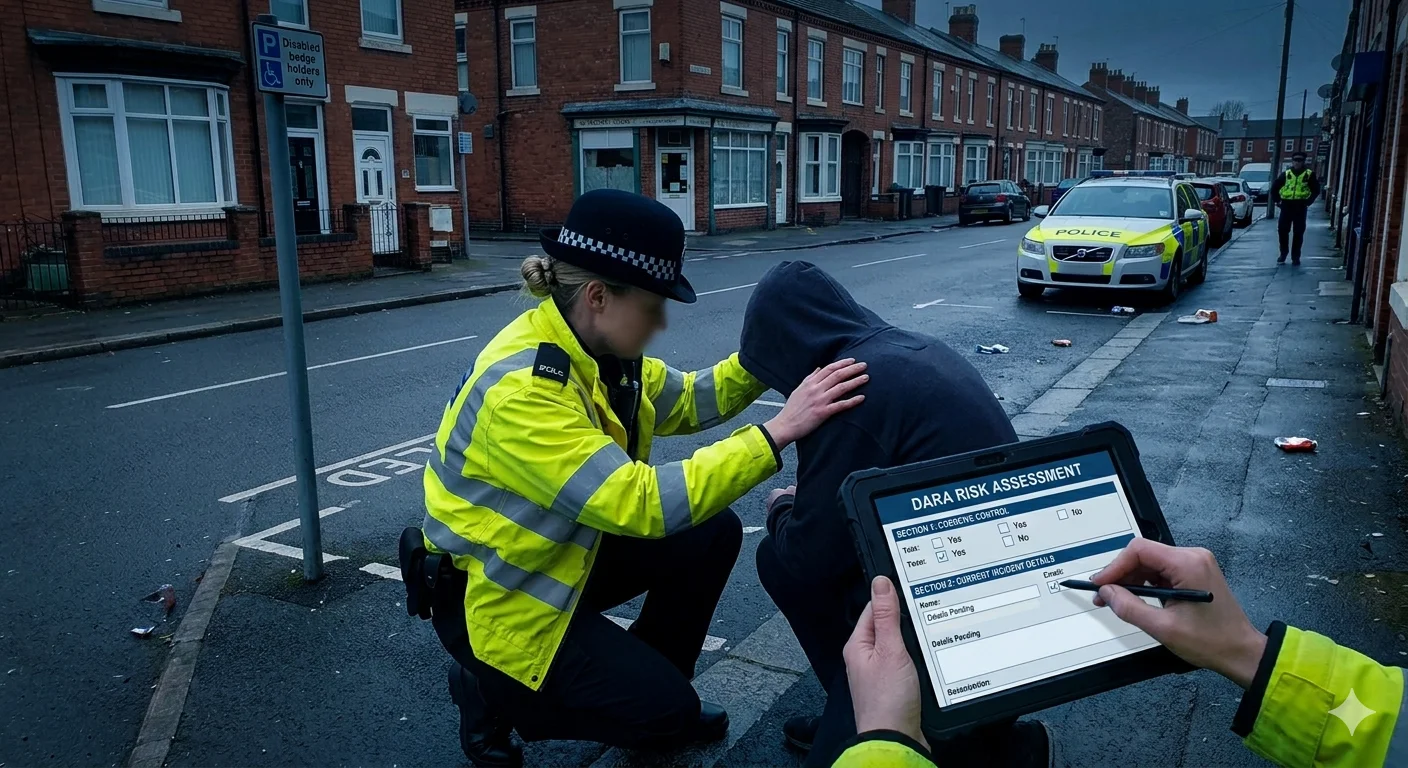
Read the articleAI-generated editorial illustration of an English high street at dusk. No real incident depicted.
Key points
- 26 October 2026 is the start date. Until then, use the existing powers and limits.
- Respect Orders are for adults aged 18+. A court can ban harmful behaviour and require action to address it. No criminal conviction is needed first.
- Dispersal directions can last up to 72 hours. The area's authorisation still lasts no more than 48 hours.
- Police closure notices can last longer: up to 48 hours, or 72 hours with superintendent authority.
- CPN and PSPO fixed penalties rise from a £100 maximum to £500. That is a ceiling, not an automatic amount.
- Check the type of breach. Missing a court-declared activity requirement has a specific warning rule.
Legal start date; Respect Order rules; Changes to time limits; Fixed penalty changes.
From 26 October 2026, police and partners in England and Wales get new and revised powers to deal with anti-social behaviour. The biggest addition is the Respect Order: a court order for adults that can stop specified behaviour and require them to take steps to change it.
The practical job is straightforward. Choose a power that fits the behaviour, explain exactly what must change, and check whether people are safer afterwards. More powers will achieve little if nobody follows up the case.
What changes on 26 October?
Use today's limits
Individual dispersal direction: up to 48 hours.
Police closure notice: up to 24 hours, or 48 hours with superintendent authority.
CPN or PSPO fixed penalty: up to £100.
Use the new limits
Individual dispersal direction: up to 72 hours.
Police closure notice: up to 48 hours, or 72 hours with superintendent authority.
CPN or PSPO fixed penalty: up to £500.
The maximum is not the default. Choose a justified period or penalty. The fixed penalty limit is separate from any court fine. Legal start date; Changes to time limits; Fixed penalties.
Respect Orders start on the same date. There are also separate youth and housing injunctions, new closure powers for registered social housing providers, and extra duties to review unresolved ASB cases. These are explained below.
Existing injunctions do not turn into Respect Orders. Injunctions already granted, and applications already made, are protected by the transition rules. What happens to existing cases.
Respect Orders: stop the behaviour and require change
A Respect Order can tell an adult what they must stop doing and what they must do. A restriction might keep someone away from a location linked to intimidation. A requirement might involve a supervised activity to address their behaviour. Each condition needs evidence behind it; these are possible uses, not wording to copy into every application.
The police, council or another eligible organisation applies to the County Court or High Court. The person must be 18 or over. They do not need a criminal conviction.
The court must decide that it is more likely than not that the person has carried out, or threatens, behaviour causing or likely to cause harassment, alarm or distress. It must also decide that making the order is fair and appropriate to prevent ASB. The Act calls this “just and convenient”. Respect Order rules.
Assess the risks before applying. That includes harm to others, the person's own vulnerabilities and whether another response could prevent the behaviour. If the order requires an activity, there must be a named supervisor and evidence that the requirement is suitable and can be enforced. Work, education and other court orders must be accommodated as far as practicable. Respect Order rules, sections A1, D1 and J1.
Be specific about the behaviour, location and duration. Check that any service the person must attend actually exists and can accept them. An instruction they cannot follow is a poor starting point.
Check what the person was required to do
Breaking a ban: breach without a reasonable excuse is a criminal offence. The activity-warning rule does not apply to prohibited conduct.
Failing an activity requirement: where the court has formally labelled it an activity requirement, breach is only an offence if a warning about that requirement was given within the previous 12 months. Where the statutory warning duty applies, the supervisor must give and record a written warning.
Get the order, evidence of what happened, any explanation and the warning record where needed. Arrest is not automatic.
The maximum sentence for the breach offence is two years' imprisonment in the Crown Court. Respect Order rules, sections H1–I1; Arrest grounds and necessity.
Which power fits the problem?
Start with what is happening and who is being harmed. These powers are not steps on a ladder that must be climbed in order. Each has its own conditions.
CPW and CPN: require a repeated problem to stop
A Community Protection Notice can require someone aged 16 or over, or an organisation, to stop or put right behaviour. It must be unreasonable, persistent or continuing, and damaging local quality of life.
Give a written warning first and allow enough time to comply. This is commonly called a Community Protection Warning. A CPN can follow if the behaviour continues and the legal conditions are still met.
The warning must offer a real chance to comply
There is no fixed minimum number of hours. The question is whether enough time has passed for this person to comply with this warning. Record the behaviour that continued afterwards.
Use clear, reasonable conditions aimed at the problem. Breaching a CPN can be an offence, but reasonable steps to comply and reasonable excuses must be considered.
CPN conditions and written warning; CPN breach and defences. Police, councils and designated persons can issue notices. The fixed penalty ceiling changes on 26 October.
CBO: after a criminal conviction
A Criminal Behaviour Order is made by the criminal court on a prosecution application. It can ban behaviour and require supervised action to prevent further ASB.
The behaviour must be proved to the criminal standard, and the court must consider that the order will help prevent it. Breach is a criminal offence.
PSPO: rules for a public place
A Public Spaces Protection Order lets a council restrict specified activities in a public place. The activities must have, or be likely to have, a persistent or continuing, unreasonable effect on local quality of life, justifying the restrictions.
The council must follow consultation and publicity rules. Orders normally last up to three years and can be extended if justified. Alcohol restrictions have a separate enforcement process.
Criminal Behaviour Orders; Public Spaces Protection Orders; Alcohol restrictions.
Youth injunctions: ages 10–17
The youth court can make an injunction to prevent ASB. It can last no more than 12 months. Consult youth justice services and consider the child's needs.
Breach follows the injunction enforcement process. It is not the new Respect Order offence.
Housing injunctions: adults
For people aged 18 or over, the County Court or High Court can address housing-related nuisance or annoyance through a housing injunction.
Eligible organisations must apply and meet the court's legal test. This also has a separate breach process from Respect Orders.
Youth and housing injunction rules. Both routes use the civil standard of proof and the “just and convenient” test.
Vehicle seizure has already changed. Since 29 June 2026, the previous warning requirement under section 59 has been removed. Officers still need reasonable grounds to believe the vehicle is being, or has been, used contrary to the careless-driving or off-road-driving provisions, and is causing or likely to cause public alarm, distress or annoyance. Noise alone does not establish that test. Vehicle seizure rules; June start date.
Longer powers do not mean every deadline changes
Dispersal: 72 hours for the person, 48 hours for the area. From 26 October, a uniformed constable can direct a person to leave for up to 72 hours where there are reasonable grounds to suspect their behaviour has contributed, or is likely to contribute, to harassment, alarm, distress, crime or disorder in the area. The direction must be necessary to reduce that risk. The inspector's written authorisation to use dispersal powers in the area still lasts no more than 48 hours. A direction issued while that authorisation is active can continue after it ends.
If a person's direction exceeds 48 hours, an inspector or above must review it as soon as reasonably practicable after the first 48 hours. Changes to time limits; Area authorisation; Individual direction.
Closure: the notice and the court order do different jobs. A notice temporarily restricts access to premises linked to nuisance or disorder. It cannot exclude the owner or people who normally live there. A court order can restrict their access, but the court must be satisfied that the more demanding conditions for an order are met and that closure is necessary.
From 26 October, police notices can last up to 48 hours, or 72 hours with superintendent authority. Registered social housing providers also gain closure powers for premises they own or manage. A court's closure order can last up to three months initially, extendable to six months in total if justified. Changes to time limits; Housing-provider closure powers; Closure notices; Closure orders.
Give someone responsibility for what happens next
Before officers use the new powers, the force's ASB lead should agree with councils, housing providers and legal services who prepares applications, supervises requirements and responds when an order is broken. Officers need access to the current order out of hours. Victims need to know who will contact them.
Record what the behaviour does to people's lives: lost sleep, fear of leaving home, threats and repeated disruption. Check vulnerabilities on both sides. Moving someone away from one street can move the problem elsewhere. Excluding someone from home can create an urgent housing or safeguarding need.
If repeated reports have not resolved the problem, explain the ASB Case Review. A victim or their representative can ask agencies to review their response where the local threshold is met. This examines what agencies have done; it is not an order against the person causing harm.
From 26 October, the local policing body, usually the Police and Crime Commissioner, has extra review and awareness duties. It must publish its procedure, promote the ASB Case Review and carry out a further review on a qualifying application where it considers the threshold was met. New review duties.
Set a date to check whether the behaviour has stopped, whether victims feel safer and whether the problem has moved. These are practical recommendations, not evidence that the new orders have already been shown to work better. Counting notices and orders tells us how much paperwork has been issued. The test is whether people can live without the harm that brought them to police.
Four powers. Four clear workflows.
Print, share by email or use at a team briefing. Every resource carries its jurisdiction, version and legal check date.
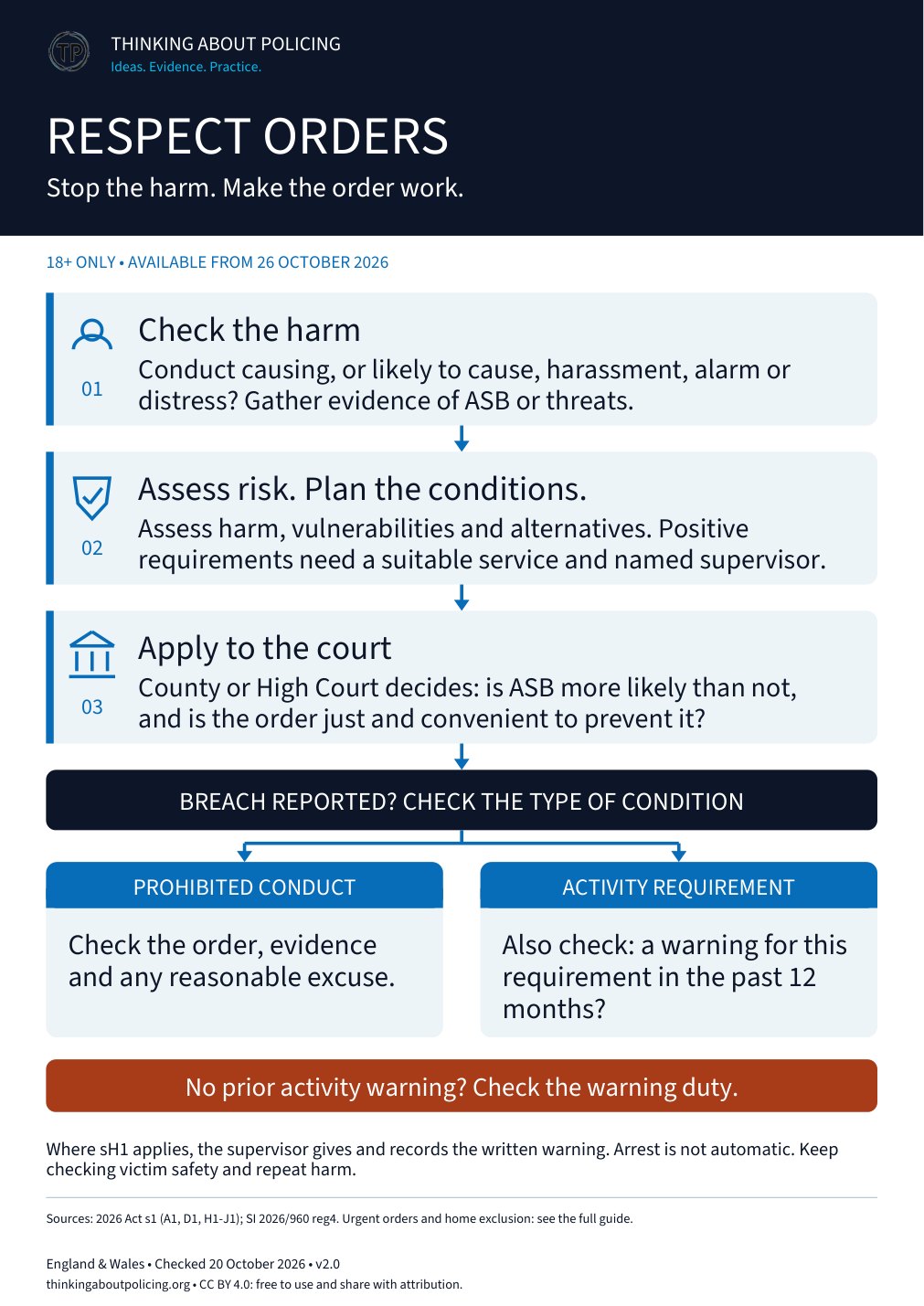
Respect Orders
A simple route from assessing harm to managing a breach.
Download A3 poster ↓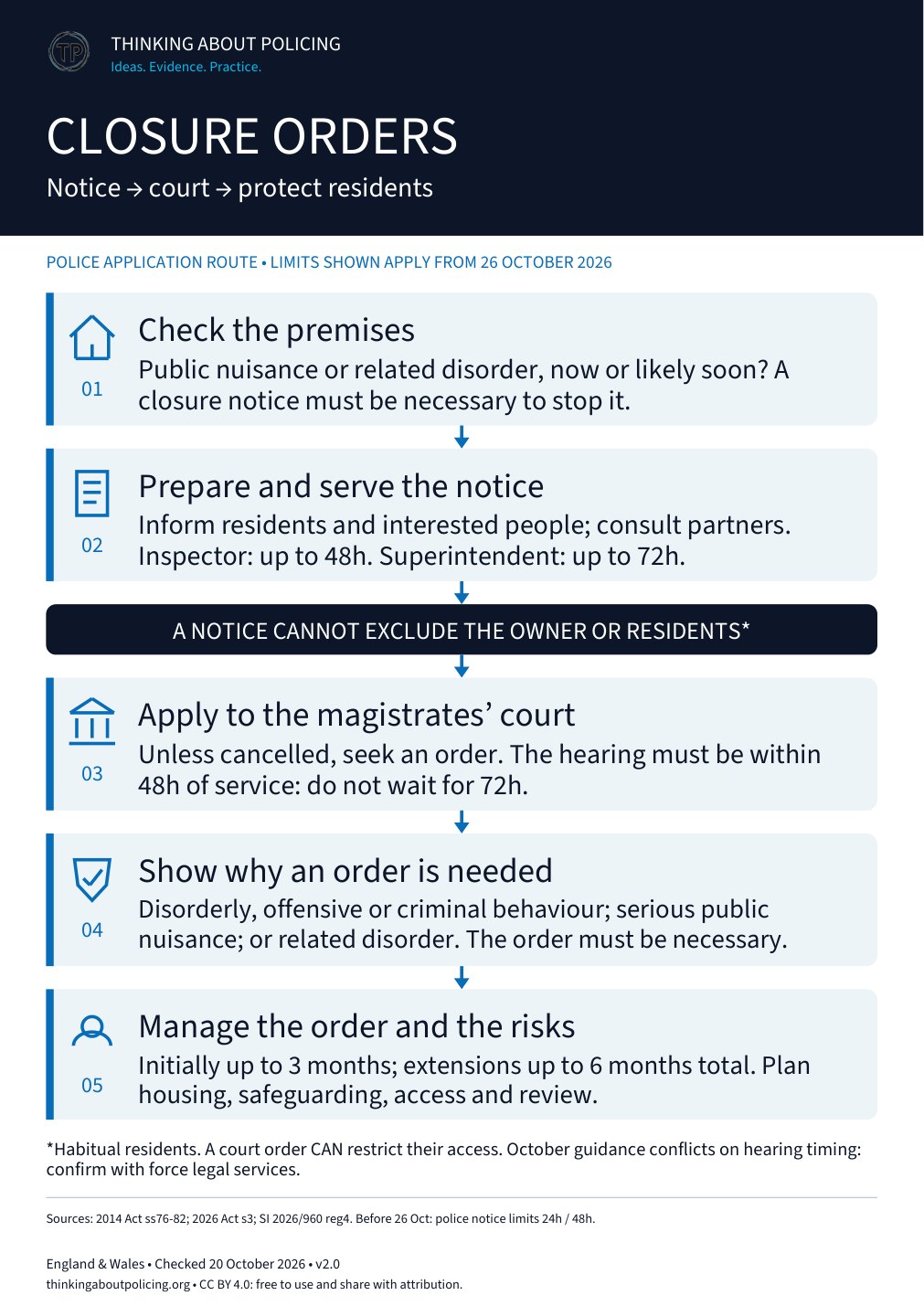
Closure orders
The police route: assess the premises, serve notice, apply to court and protect residents.
Download A3 poster ↓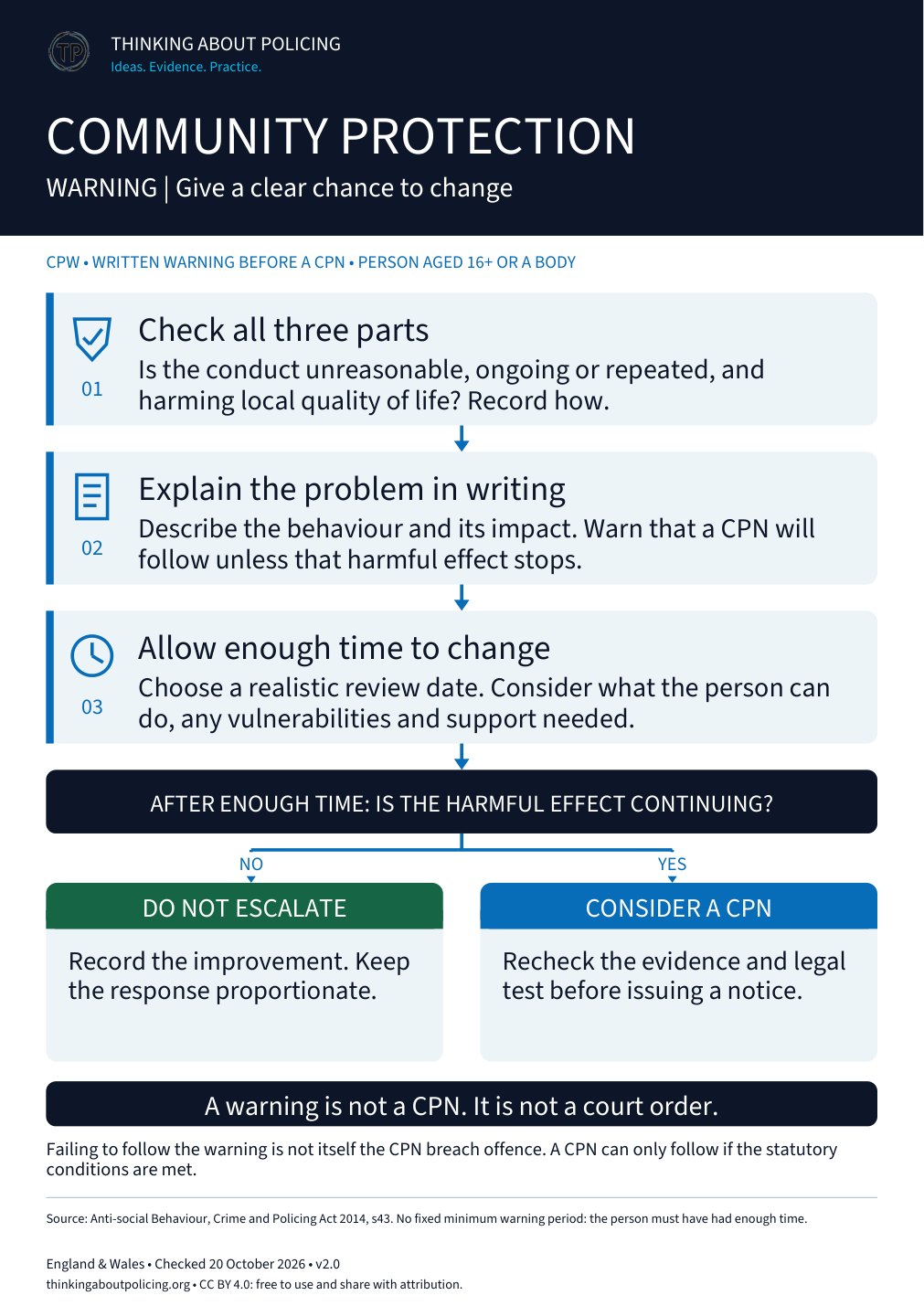
Community Protection Warning
Start with the conduct, give a clear written warning and allow enough time.
Download A3 poster ↓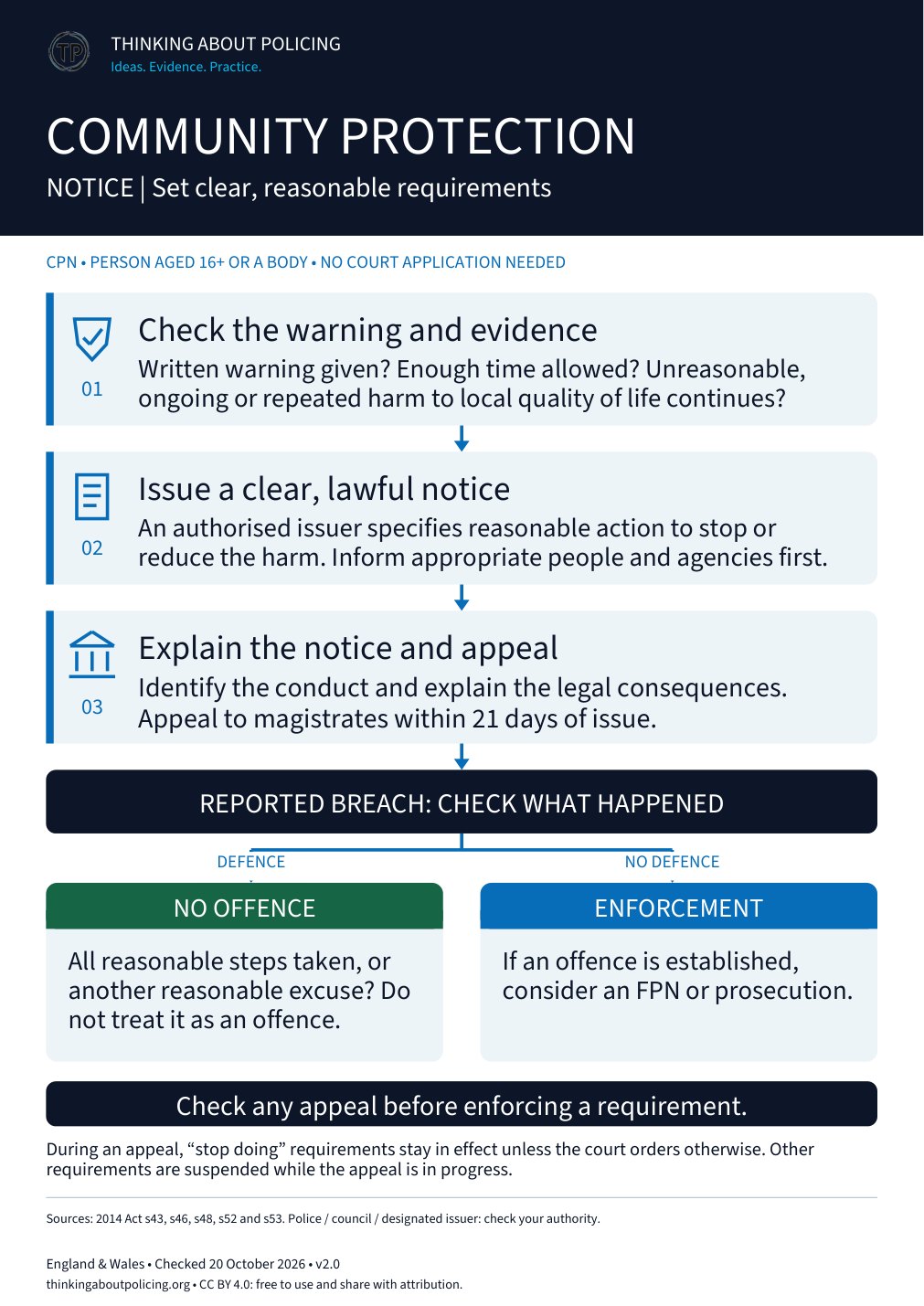
Community Protection Notice
Check the warning, set reasonable requirements and respond lawfully to a breach.
Download A3 poster ↓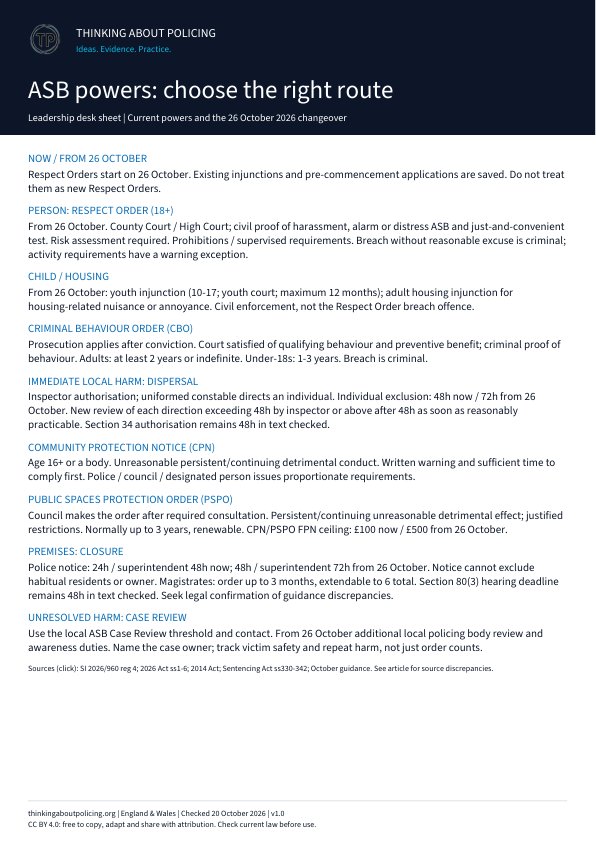
A4 powers guide
A one-page desk reference for the wider ASB toolkit.
Download PDF ↓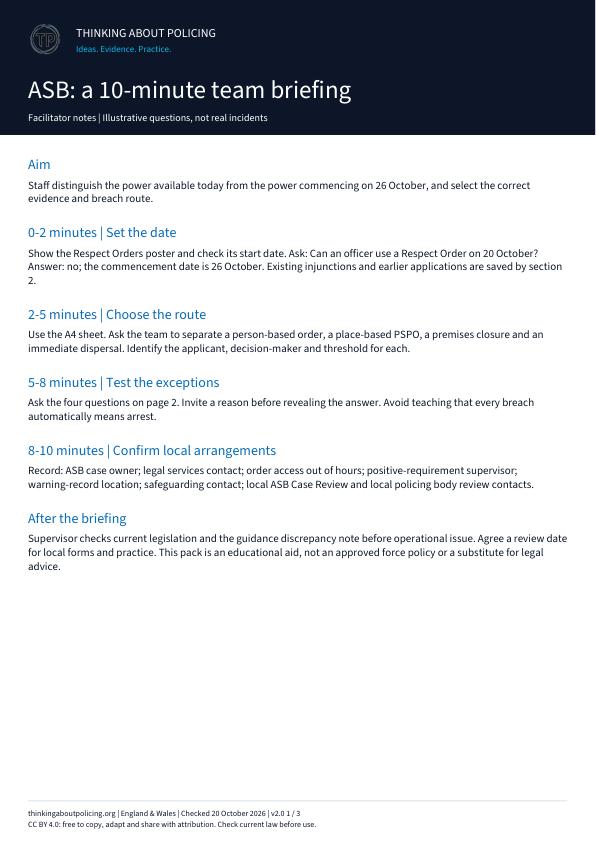
10-minute team briefing
Facilitator notes, questions and a local implementation record.
Download PDF ↓© Thinking About Policing 2026. Original text and training layouts: CC BY 4.0. Free to copy, adapt and redistribute, including commercially, with attribution, a licence link and an indication of changes. Keep the legal check date visible. TAP’s logo identifies the source; it does not endorse adaptations. Legislation and government guidance retain their Crown copyright / Open Government Licence terms. Educational briefing; verify current law and local legal advice before operational use.
Source and method note. Targeted legal review checked 20 October 2026 against legislation.gov.uk: 2014 Act, Sentencing Act 2020, 2026 Act and commencement instruments. October 2026 Home Office guidance was checked alongside the statutory text; material timing discrepancies are identified above. This is not an effectiveness evaluation or a substitute for force legal advice.
Further TAP reading: The power of civil orders.