ASB Powers: A Frontline Guide to Notices and Orders
In brief
A practical guide to Community Protection Notices, civil injunctions, Criminal Behaviour Orders and closure powers in England and Wales — including what is in force now, what the Crime and Policing Act 2026 changes, and where Respect Orders fit next.
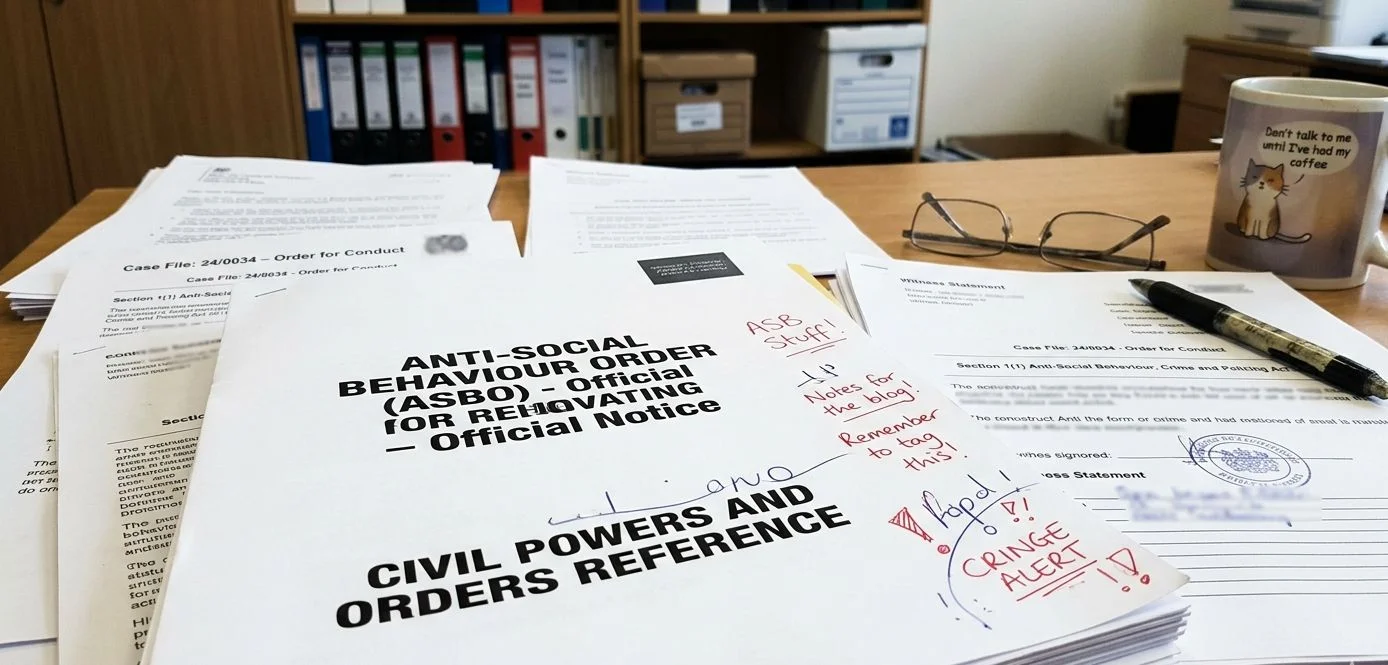
Anti-social behaviour powers are useful because they can change what happens next, not because they offer a more elaborate way to record what has already happened. A warning can define the behaviour that must stop. A notice can require action. A court order can prohibit contact, exclude someone from a place or close premises that have become a focus of harm.
For frontline policing in England and Wales, the central framework remains the Anti-social Behaviour, Crime and Policing Act 2014. Community Protection Notices, civil injunctions, Criminal Behaviour Orders and closure powers are all established within it, supported by Home Office statutory guidance.
The legal position is now complicated by two 2026 Acts. The Sentencing Act 2026 changed adult bail and remand law from 22 March 2026. The Crime and Policing Act 2026 has enacted Respect Orders and several changes to existing ASB powers, but implementation is not the same thing as Royal Assent. The Home Office says Respect Orders will be brought into use as soon as practicable and that further information will follow. Ministry of Justice, 19 March 2026; Home Office, 19 May 2026.
That distinction should sit at the front of any operational briefing. An enacted power is not necessarily a power an officer can use today.
The first question is not “which order is strongest?” It is “which power is in force, meets this test and solves this problem?”
Bail has changed, but orders are not substitutes for remand
The Sentencing Act 2026 amended the Bail Act 1976 so that, for adults, fewer exceptions to bail apply where the court considers there is no real prospect of an immediate custodial sentence. The Ministry of Justice says the amendments commenced on 22 March 2026 and form part of a package intended to reduce the prison remand population. Ministry of Justice circular; Sentencing Act 2026 explanatory notes.
The change is narrower than saying that prolific offenders will now simply be bailed. Courts retain the Bail Act framework and can refuse bail where an applicable statutory exception is made out. CPS guidance also cautions that “no real prospect” of immediate custody is a demanding test rather than another way of saying custody is merely unlikely. CPS — Bail.
The practical consequence is that officers should not rely on remand as an incidental safeguarding plan. Where a defendant is lawfully on bail, police still need to consider bail conditions, victim safety measures and any separate ASB power that independently meets its statutory test.
A CPN, injunction, CBO or closure order does not exist to compensate for a failed remand application. It exists because the behaviour or premises independently meets the legal test for that power.
Community Protection Notices deal with persistent unreasonable conduct
A Community Protection Notice (CPN) is available under sections 43 to 58 of the 2014 Act. It is designed for conduct that:
- has a detrimental effect, of a persistent or continuing nature, on the quality of life of those in the locality; and
- is unreasonable.
A CPN can require a person or body to stop doing specified things, do specified things or take reasonable steps to achieve a stated result. The recipient must normally first receive a written warning identifying the conduct and making clear that a CPN will be issued if it continues. 2014 Act, section 43; Home Office statutory guidance.
That gives the warning real operational value. It defines the conduct and gives the person an opportunity to stop before criminal liability for breach of the notice becomes relevant.
The important drafting test is specificity. “Do not cause anti-social behaviour” tells the recipient and the officer enforcing the notice very little. “Do not leave commercial waste in the rear alley of X Road” or a similarly precise requirement can be assessed against observable conduct.
The Crime and Policing Act 2026 legislates for a higher maximum fixed penalty for breach of a CPN, from £100 to £500, alongside other ASB changes. Officers should use the penalty and procedure currently in force in their force area and current guidance rather than assuming every 2026 amendment commenced on Royal Assent. Home Office ASB factsheet.
Civil injunctions remain part of the current framework
Part 1 of the 2014 Act provides for civil injunctions against anti-social behaviour. For adults, applications are generally made in the county court or High Court; youth cases go to the youth court. The court can impose prohibitions and positive requirements where the statutory conditions are met. Anti-social Behaviour, Crime and Policing Act 2014, Part 1.
The injunction matters because it can intervene without waiting for a criminal conviction. That does not make it a shortcut around evidence. The applicant still has to establish the statutory test and persuade the court that the proposed terms are appropriate.
The Crime and Policing Act 2026 will partially replace the adult civil-injunction model with a new Respect Order. The new order is civil when made but breach will be a criminal offence; it can also include positive requirements. Crime and Policing Act 2026; Home Office ASB factsheet.
As of 10 August 2026, however, the Home Office says only that Respect Orders will be implemented “as soon as practicable”. They should therefore be taught as an imminent statutory change, not as an order officers can already request in place of the existing injunction. Home Office, 19 May 2026.
Criminal Behaviour Orders start with a conviction
A Criminal Behaviour Order (CBO) under section 22 of the 2014 Act is different because it is made following conviction. The prosecution may apply and the court must be satisfied of the statutory conditions, including that the offender has engaged in behaviour causing or likely to cause harassment, alarm or distress and that making the order will help prevent such behaviour.
CBOs can contain prohibitions and positive requirements. In practice they are often used against persistent offenders whose behaviour repeatedly harms the same victims, businesses or places. The order can extend protection beyond the immediate sentence, but only if its terms are properly connected to the behaviour the court is trying to prevent.
The Crime and Policing Act 2026 also introduces a presumption in favour of a CBO on a first conviction for the new offence of assaulting a retail worker, subject to the statutory scheme when those provisions are commenced. Home Office retail-crime factsheet.
That does not turn CBOs into a standard add-on for every retail case. Their terms still need to be justified and enforceable.
Closure powers follow the premises rather than the person
Closure powers under Part 4, Chapter 3 of the 2014 Act allow police and local authorities to act against premises associated with nuisance, disorder or criminal behaviour.
Under the current 2014 framework described by the Home Office, a closure notice can be followed by an application to a magistrates’ court for a closure order. A closure order can prevent access by specified people or, where justified, anyone including residents. Home Office ASB factsheet.
These powers are particularly significant where a property has become a base for drug supply, exploitation or repeated disorder. The legal order solves only the access problem. If the premises belong to a vulnerable person who has been coerced or “cuckooed”, housing and safeguarding work remains essential. Closing the address without protecting the occupant can move the victim and leave the exploitation problem intact.
The Crime and Policing Act 2026 legislates to extend closure notices from 48 to 72 hours, allow registered social housing providers to issue notices and create a power to change maximum closure-order durations by regulation. The Act’s explanatory notes describe those reforms, but operational guidance should identify the commencement position before officers act on the new time limits or issuer powers. Crime and Policing Act 2026 explanatory notes.
The wording of an order is an operational issue
A restriction that nobody can understand or enforce is a poor restriction even if the underlying case is strong.
The Court of Appeal’s decision in R v Boness [2005] EWCA Crim 2395, concerning an ASBO under the previous regime, set enduring principles around proportionality and clarity in behavioural orders. Terms should be necessary, realistic and capable of enforcement. R v Boness [2005] EWCA Crim 2395.
Those principles translate directly into practical drafting:
- define geographical exclusions precisely and attach a map where needed;
- prohibit observable behaviour rather than vague concepts;
- avoid conditions that unnecessarily prevent lawful work, housing or treatment;
- make positive requirements achievable and identify who will supervise them;
- ask whether an officer encountering the person at 2am could tell from the wording alone whether a breach had occurred.
The stronger the restriction, the stronger the justification should be.
Choosing the power should start with the problem
The useful distinction is not “civil powers versus criminal justice”. Each tool addresses a different problem.
| Power | Starting point | Core use | Consequence of breach |
|---|---|---|---|
| CPN | Persistent, unreasonable conduct affecting local quality of life | Stop or remedy specified continuing behaviour | Criminal offence |
| Civil injunction | ASB meeting the Part 1 test; no conviction required | Court-ordered prohibitions or positive requirements | Contempt of court, with statutory arrest provisions in defined cases |
| CBO | Criminal conviction plus the statutory behaviour/prevention tests | Longer-term control of persistent offending-related ASB | Criminal offence |
| Closure power | Problem premises associated with nuisance, disorder or crime | Restrict access to premises | Criminal offence for prohibited entry/obstruction |
| Respect Order | New adult civil behavioural order under the 2026 Act | Persistent adult ASB, with prohibitions and positive requirements | Criminal offence once the scheme is commenced |
The table is an orientation aid, not a substitute for the statute, current guidance or force legal advice.
A sound decision therefore asks:
- What exact behaviour or premises-related harm are we trying to stop?
- Which statutory test is met by the evidence we actually have?
- What is the least restrictive power capable of addressing that harm?
- Are the proposed conditions precise and enforceable?
- What safeguarding, housing, treatment or problem-solving work needs to sit alongside the legal restriction?
This is closer to the National Decision Model than to a mechanical escalation ladder. Sometimes an informal warning is proportionate. Sometimes the evidence and risk justify going directly to court. The statute, not habit, decides what preconditions apply.
What supervisors should check
Supervisory oversight is most useful before a notice is served or an application reaches court.
For a CPN, the supervisor should be able to identify the persistent conduct, its effect on local quality of life, why it is unreasonable, what warning has been given and why each requirement is proportionate.
For an injunction or CBO, the proposed term should be tested against the evidence and against ordinary life. An exclusion zone that prevents legitimate employment or accommodation may cause more difficulty than it solves unless that restriction is genuinely necessary.
For closure action, the plan should identify who is displaced, who is vulnerable and what happens when the order ends.
And for every power affected by the 2026 legislation, the first check should be commencement. Royal Assent establishes the law Parliament has enacted. It does not tell an officer that every provision is operational today.
The practical opportunity is better problem-solving, not more orders
The strongest case for ASB powers is not that police should issue more of them. It is that officers should be able to use the right one when repeated harm cannot be solved by another arrest or another incident log.
The 2026 bail changes make that capability more relevant in some cases because remand will be unavailable where the amended statutory test points strongly towards bail. The Crime and Policing Act will also change the ASB toolkit as its provisions commence. Neither development removes the need for proportionality or evidence.
A good order is a specific answer to a specific recurring problem. It identifies the conduct, protects the victim or place, can be understood by the person bound by it and can be enforced by the officer who encounters the next breach.
That is the standard worth training for. The paperwork follows from it.
Sources and further reading
- Anti-social Behaviour, Crime and Policing Act 2014
- Home Office — Anti-social behaviour powers: statutory guidance for frontline professionals, updated 17 September 2025
- Sentencing Act 2026 — explanatory notes, Part 3
- Ministry of Justice — Bail Act amendments circular, 19 March 2026
- Crime and Policing Act 2026
- Home Office — Crime and Policing Act 2026: anti-social behaviour factsheet, 19 May 2026
- Crown Prosecution Service — Criminal Behaviour Orders
- R v Boness [2005] EWCA Crim 2395
Discussion questions
- 01
Which ASB powers can your frontline officers use confidently without referring every case to a specialist team?
- 02
Do supervisors test whether proposed order terms are necessary, proportionate and enforceable before an application is made?
- 03
Has your force briefed officers clearly on which Crime and Policing Act 2026 ASB provisions are enacted but not yet commenced?