What is a PSPO, and can it reduce street harassment?
In brief
Public Space Protection Orders are being used against sexual harassment in Bradford and London. They make local enforcement possible, but evidence that they reduce harassment remains limited.


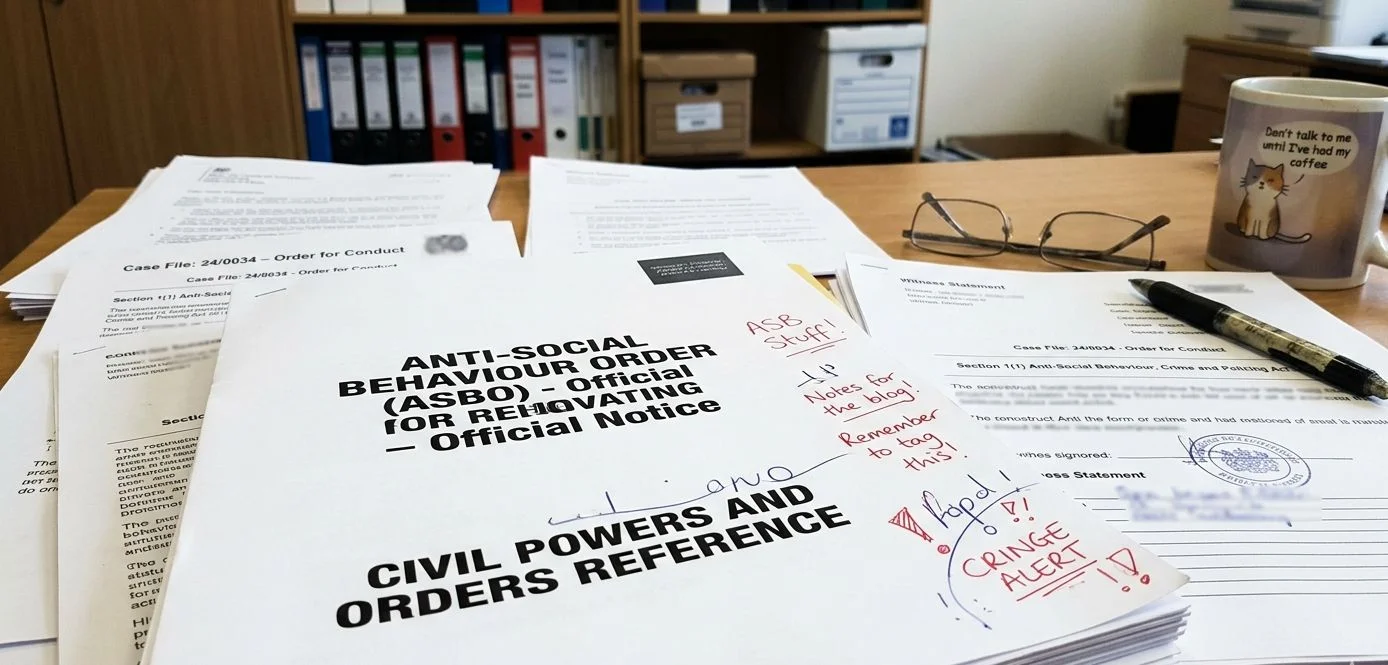
A Public Space Protection Order, usually shortened to PSPO, is a legal power that lets a council restrict specified behaviour in a defined public place. In England and Wales they are commonly used for street drinking, nuisance vehicles, dog controls and other persistent local problems.
They are now being used against public sexual harassment too: following women, unwanted sexual comments or propositions, sexually intimidating behaviour and other specified conduct.
Bradford, Redbridge and Hammersmith & Fulham show that PSPOs can give police and council officers another way to intervene. What they do not yet show is that the orders reduce how often women experience harassment.
The evidence supports a narrower conclusion: PSPOs are a credible enforcement and place-based problem-solving tool. They are not yet an evidenced solution to street harassment.
What is a PSPO?
PSPOs come from Part 4, Chapter 2 of the Anti-social Behaviour, Crime and Policing Act 2014. A local authority can make one where activities in a public place have, or are likely to have, a detrimental effect on the quality of life of people in the locality. The effect must be persistent or continuing, or likely to be; the activities must be unreasonable; and the restrictions must be justified. Anti-social Behaviour, Crime and Policing Act 2014 — Public Spaces Protection Orders.
The council defines the place and the prohibited or required behaviour. One order might restrict alcohol. Another might prohibit nuisance vehicle use. A third can identify particular forms of harassment. The restrictions must be reasonable and necessary to prevent or reduce the detrimental effect or risk. Anti-social Behaviour, Crime and Policing Act 2014, sections 59–61.
Orders normally last for up to three years and can be extended if the statutory conditions remain satisfied. Breaching one without reasonable excuse is a criminal offence; fixed penalty notices can also be used where the legislation permits. Anti-social Behaviour, Crime and Policing Act 2014, sections 60, 67 and 68.
This article concerns England and Wales. Scotland and Northern Ireland have different legal arrangements.
How can a PSPO cover sexual harassment?
The individual order must identify enforceable conduct. A council does not simply make “misogyny” illegal.
Redbridge’s borough-wide Public Sexual Harassment PSPO, in force from 25 November 2024 to 24 November 2027, covers unwanted intrusive or persistent staring or questioning, following someone, sexual or obscene comments, propositions or gestures, and threatening or intimidating another person using sexual language or sexual suggestions. London Borough of Redbridge — PSPOs in force.
That focus on observable conduct matters. Following somebody or repeatedly making unwanted sexual comments can be evidenced and tested against the order. A broad judgement that somebody is “misogynistic” is much harder to turn into a proportionate public-space restriction.
The PSPO does not displace criminal law. Where an incident meets the elements of another offence, officers still need to consider it.
Where have these orders been used?
Bradford: Operation Soundwood
The Operation Soundwood practice published by the College of Policing is the clearest policing example.
The University of Bradford raised concerns in 2022 that women felt unsafe around campus. The College says police systems contained few relevant crime and intelligence reports despite significant community concern. Partners identified reluctance to report and uncertainty about how to report incidents. College of Policing — Operation Soundwood, 22 September 2025.
University security and students’ union welfare staff were trained to submit intelligence through a West Yorkshire Police portal. Partners also recognised that an existing PSPO aimed at anti-social vehicle use already prohibited shouting at, threatening or intimidating another person, including through sexual language or sexual suggestions. College of Policing — Operation Soundwood.
The College reports 30 operations and 29 PSPO breaches, including 19 involving inappropriate behaviour towards women and girls. It classifies Soundwood as Untested. The published entry does not report a comparison area, repeated victimisation measure or causal evaluation showing that harassment fell because of the PSPO. College of Policing — Operation Soundwood.
Soundwood therefore demonstrates an operational mechanism. It does not yet demonstrate reduced prevalence.
Redbridge and Hammersmith & Fulham
Redbridge reported issuing a £100 fixed penalty notice in December 2022 after enforcement officers witnessed a woman being harassed in Ilford. It later created the dedicated borough-wide Public Sexual Harassment PSPO now in force. London Borough of Redbridge — 20 December 2022; Redbridge — current PSPOs.
Hammersmith & Fulham approved a borough-wide Street Harassment PSPO on 21 June 2024, effective from 27 June. Its decision record says 84.5% of consultation respondents supported the proposal and records planned staff training and an educational campaign. That percentage describes consultation respondents, not all borough residents. Hammersmith & Fulham — decision record.
These schemes establish that harassment-specific PSPOs can be made and enforced. A fine proves enforcement happened. An order being in force proves implementation. Neither tells us whether women now encounter less harassment.
What evidence is there that PSPOs reduce harassment?
For sexual-harassment PSPOs specifically, the published evidence is weak.
Bradford is explicitly Untested. The Redbridge and Hammersmith & Fulham material describes the local problem, order and enforcement approach rather than a controlled impact evaluation. I did not identify a published evaluation using consistent before-and-after measures of women’s exposure to harassment, with a suitable comparison, for any of the schemes reviewed here.
The wider evidence on civil preventive powers is also thin. Zoe Rodgers’ 2023 systematic review considered 24 civil preventive orders and notices in England and Wales but found only 13 original empirical studies. Its search identified no empirical study specifically examining PSPO policing during the review period, and most studies across the wider family of powers had limited effectiveness data. The review covered research available up to 2022, so it cannot evaluate the later Redbridge or Hammersmith & Fulham schemes. Rodgers (2023), Policing: A Journal of Policy and Practice.
The Home Office’s 2026 VAWG evidence review, drawing on 125 systematic reviews and meta-analyses after screening more than 2,000 papers, also describes most public-space initiatives as having limited evidence and identifies stalking and harassment among continuing gaps. Home Office — What works to reduce violence against women and girls, updated 26 May 2026.
This is not evidence that PSPOs fail. It means claims of success should stay within what has actually been measured.
Enforcement figures can mislead
A PSPO that improves reporting and detection can produce more recorded incidents and breaches, even if underlying behaviour is unchanged or falling. Bradford deliberately tried to close an intelligence gap, so increased reporting could be an intended effect of the intervention. College of Policing — Operation Soundwood.
Fewer reports are equally ambiguous: they could mean less harassment or less confidence in reporting.
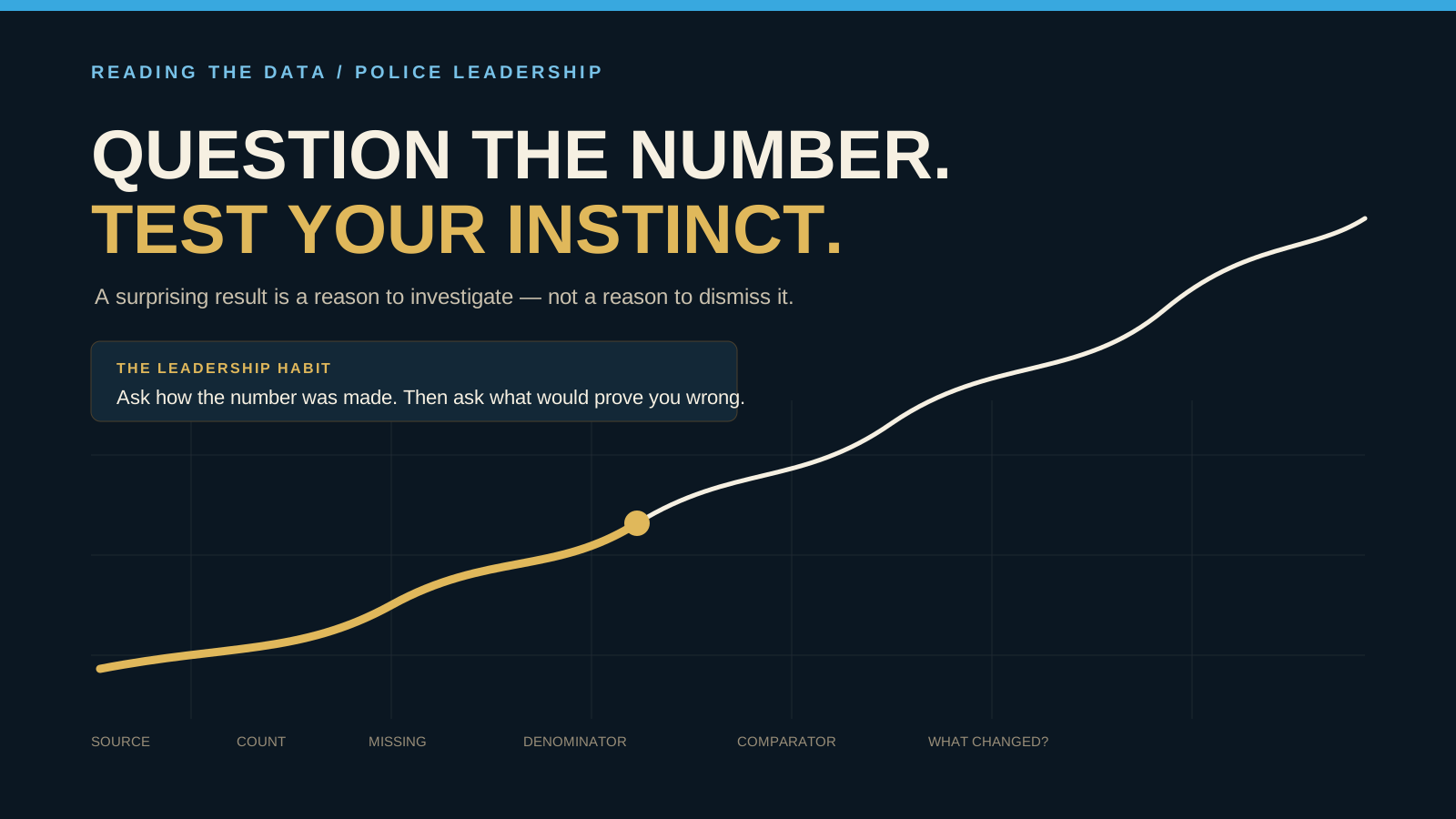
Breach counts are therefore implementation measures, not the main outcome. The outcome should be women’s exposure to the behaviour the order was created to reduce. Repeated surveys using a consistent method, ideally alongside a suitable comparison area, would tell leaders far more than a count of fixed penalty notices.
What evidence would change this judgement?
The current conclusion should not become a permanent sceptical position. It should move when better outcome evidence arrives.
A convincing positive evaluation would begin with a clear pre-intervention measure of the behaviours covered by the order, repeat the same measure after implementation and show a reduction larger than any change in a credible comparison area. It would also check neighbouring locations for displacement and record other interventions introduced at the same time. If the fall were sustained, and the design gave reasonable grounds to attribute at least part of it to the PSPO package, the case for effectiveness would become materially stronger.
The reverse matters too. If enforcement increased but repeated surveys showed no reduction in women’s exposure to harassment, leaders should not renew the order simply because officers had issued penalties. If behaviour moved beyond the boundary, the scheme would need redesign rather than a success claim.
A weaker but still useful step would be consistent before-and-after local victimisation measurement with transparent limitations. It would not establish causation on its own, but it would move the evidence beyond the current reliance on enforcement outputs and consultation findings.
The criminal-law context changed in April 2026
On 1 April 2026, the Protection from Sex-based Harassment in Public Act 2023 came into force in England and Wales and inserted section 4B into the Public Order Act 1986.
The Home Office describes section 4B as an aggravated form of the existing section 4A offence. Intentional harassment, alarm or distress must be established, together with conduct carried out because of the victim’s sex or presumed sex. The guidance is explicit that section 4B does not criminalise new behaviours. Home Office — statutory guidance for police, 1 April 2026.
PSPOs have not become redundant. A local order can cover specified conduct that does not meet every element of section 4B and can form part of a place-based response. But it should not become an easier disposal for conduct that ought to be recorded and investigated as crime.
What should councils and police do next?
There is no evidential basis for a national instruction to introduce sexual-harassment PSPOs everywhere. A council can target an evidenced hotspot, use a borough-wide order where the local case supports it, or decide existing criminal and preventive measures are preferable.
Where a PSPO is introduced, it should also be designed as an evaluation. Before commencement, councils and forces should establish a baseline and then measure:
- women’s reported experiences of the specified behaviour using a repeatable method;
- reporting and intelligence volumes;
- warnings, fixed penalties, prosecutions and repeat subjects where lawful;
- perceptions of safety, separately from victimisation;
- neighbouring locations for displacement;
- other changes introduced at the same time, such as patrols, CCTV, lighting or campaigns.
A comparison area should be used where feasible. Early reviews can test whether the scheme is being implemented properly; later reviews should ask whether the behaviour changed and whether any change lasted.
Renewal should depend on the problem the PSPO was designed to reduce, not on how many notices the enforcement team issued.
What the evidence supports now
Bradford, Redbridge and Hammersmith & Fulham establish feasibility, not effectiveness.
The evidence supports careful local use where a council can show a defined problem, draft observable prohibitions and evaluate the result. PSPO enforcement should sit alongside appropriate criminal investigation rather than replace it. PSPOs are also not the only new duty reshaping how public places are protected: Martyn’s Law brings qualifying venues under a protective-security regime that is enacted but not yet in force.
The next useful statistic is not another total of breaches. It is whether fewer women are being followed, intimidated, propositioned or subjected to unwanted sexual behaviour in the places where these orders operate.
How this review was conducted
This review checked the statutory PSPO framework, Home Office section 4B guidance, the College of Policing Practice Bank entry for Operation Soundwood, published Redbridge and Hammersmith & Fulham material, Rodgers’ 2023 systematic review and the Home Office’s 2026 VAWG evidence review. The local examples are not an exhaustive census. No controlled or repeated-victimisation evaluation specifically testing a public-sexual-harassment PSPO was identified in the sources reviewed.
Discussion questions
- 01
What should count as success when a sexual-harassment PSPO comes up for renewal: fewer self-reported incidents, greater feelings of safety, enforcement outcomes, or a combination?
- 02
How should officers decide between PSPO enforcement and investigation of a criminal offence when the same incident could engage both?
- 03
Should the College of Policing or Home Office set a common evaluation standard for local PSPOs aimed at violence against women and girls?
Related reading
- Evidence & Practice"Burgulars shoplift on their day off" Can we target high harm offenders by considering all of their offending behaviours?Oct 2026
- Leadership & CultureWhat is Police Reform and will it make a difference?Sept 2026
- Evidence & PracticeNeighbourhood Policing Guarantee: Confidence and Crime Need Different MeasuresJun 2026