
The Right to Understand
A proposed Right to Understand childhood crime records: existing access rights, new evidence on sentencing transcripts and a supported route for adult survivors.
Read the articleWritten by Nathan Tracey · England and Wales
Content note: This article discusses childhood violence, sexual abuse and traumatic experiences, without describing individual offences in detail.
An adult trying to understand a serious crime committed against them as a child should be able to ask what the state recorded, what it decided and why. Receiving a bundle of documents may answer some of those questions. It may leave others harder to ask.
The Right to Understand proposed here would provide a named guide, a chronology and a supported explanation of surviving records. It would begin with reported serious crimes against children in England and Wales. It is a proposal for testing, not an existing general legal entitlement or a promise of closure.
Evidence from care records identifies both the value of access and the harm caused by poor disclosure. New Ministry of Justice findings, published on 6 October 2026, add evidence from victims receiving sentencing transcripts. Together, they support a pilot that measures understanding and distress, rather than assuming that sending information is enough.
Updated 7 October 2026: added the sentencing-transcript pilot, clarified proposed changes to the Victims’ Code and the future transcript entitlement, and specified the ICO survey’s different denominators. The service standards below remain proposals.
Being told does not establish that a child understood
The current Victims’ Code begins with a right “to be able to understand and to be understood”. It requires accessible communication and provides rights to case information. A record that information was sent cannot establish, by itself, what a child understood or what they will remember as an adult.
The Ministry of Justice’s 2026 consultation identified weaknesses in communication with children and proposed more direct engagement adjusted to their development. The consultation is now closed. Its publication page still identifies the replacement Code as a draft; those proposals should not be presented as an implemented service.
The Children’s Commissioner for England’s 2024 report combined police material with work involving ten victims and survivors of sexual harm in childhood. It described confusion and inadequate preparation for the justice process. This was evidence about children’s experiences, not a study following their understanding through later adult life. How often an adult needs a retrospective explanation remains uncertain.
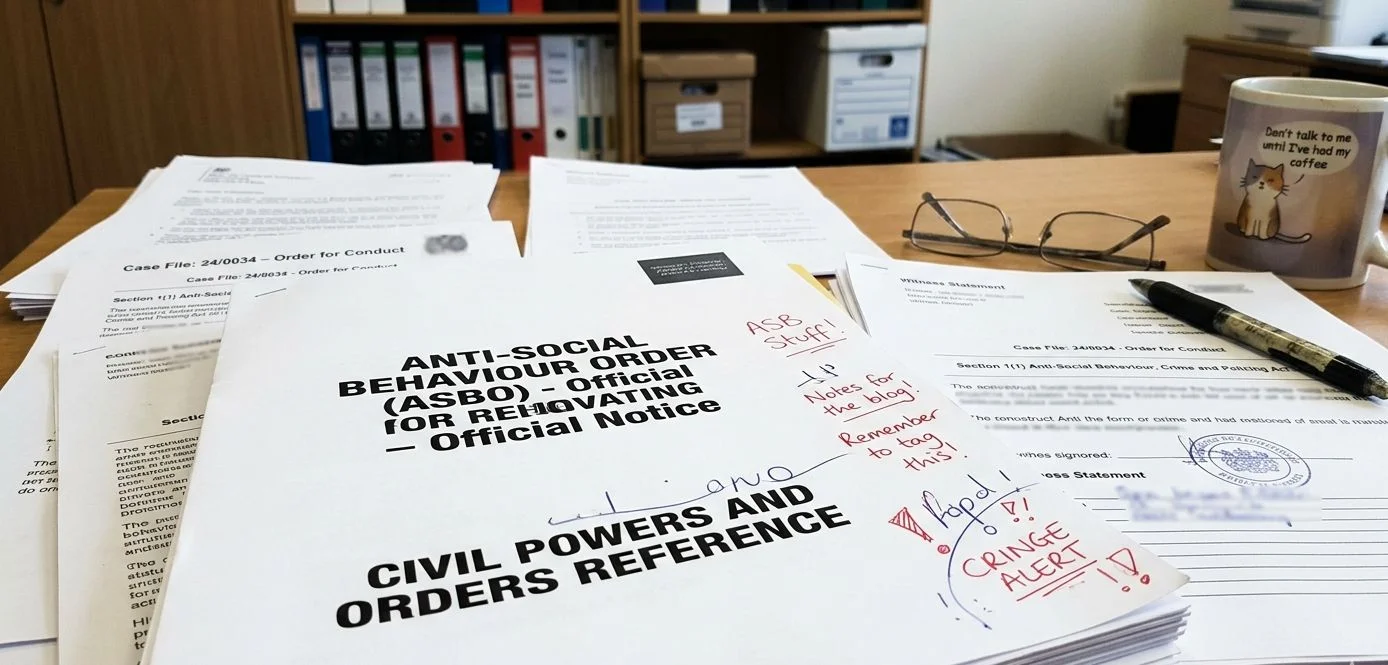
That uncertainty should shape the pilot. It should establish the questions applicants want answered and which agencies hold the relevant material. Police, prosecutors, courts and children’s services can hold different parts of a case. Access to one organisation’s records cannot automatically explain the decisions made by another.
TAP’s related article, ‘Do You Understand?’ Is Not a Comprehension Test, examines the practical difference between delivering an explanation and checking that someone can use it.
The evidence comes from people opening their own files
Direct research on adults receiving a supported explanation of a childhood criminal case is limited. That should be stated plainly. The sources reviewed for this article did not identify an evaluated national programme combining cross-agency records, a reliable chronology, explanation and continuing support. The strongest relevant evidence comes from adult care leavers and survivors of child sexual abuse accessing records about their childhoods.
The Independent Inquiry into Child Sexual Abuse concluded that records can help victims and survivors understand decisions about their care, the circumstances in which abuse occurred and why it was allowed to continue. It also found that defensive responses, procedural obstacles, poor communication and unexplained redactions could deepen a person’s sense of having been failed or covered up. Reading records could bring back traumatic memories and cause distress. IICSA therefore recommended clear access procedures, long retention periods and trained staff who understood the long-term impact of child sexual abuse and engaged with applicants with empathy.
The Information Commissioner’s Office surveyed people across the UK between February and April 2024. Its main analysis covered 172 adults with care experience or third parties seeking records for somebody close to them. Participation was voluntary, so the findings should not be treated as the prevalence of problems among all care leavers.
Among 167 respondents asked about barriers, 71% reported difficult communication and 69% said the process took longer than expected. Among 114 people who had received records, 59% said the information was insufficient and about nine in ten still had questions or concerns. The different denominators are important: the second group had reached a later stage in the process. ICO analysis, table 4 and figures 7–9.
The ICO’s Better Records Together standards distinguish legal duties from good practice, but encourage organisations to explain what records may contain, warn about gaps and lost material, offer choices about timing and format, provide a named contact and signpost counselling, advocacy or peer support. That is very close to the operating model a Right to Understand would need.
Qualitative research gives the necessary caution. Victoria Hoyle and colleagues’ participatory study, Recordkeeping and the life-long memory and identity needs of care-experienced children and young people, found positive and negative effects. Some participants used records to understand why they entered care, reduce self-blame, recover parts of their identity and place childhood events into a more coherent account. Others described depression, anxiety, anger, time away from work, relationship strain, harmful drinking and renewed trauma after opening their files. A record could be valuable and painful at the same time. Its meaning could also change as the reader grew older.

Explanation is not treatment
It would be easy to overstate what understanding can achieve. A factual chronology is not therapy. An explanatory meeting should not be sold as healing, and an applicant should never be pressed to read material because a professional thinks it will help.
There is good evidence for properly delivered trauma-focused psychological treatment. That is a different intervention, undertaken for a clinical purpose by trained practitioners over time. NICE expressly says psychologically focused debriefing should not be offered to prevent or treat post-traumatic stress disorder. That distinction applies here. A one-off meeting in which an official recounts traumatic material is not made therapeutic by calling it trauma-informed.
Nor should a case guide try to fill gaps in memory. Research on trauma narratives finds an association between post-traumatic stress symptoms and disorganised recollection, but it does not justify completing a survivor’s story for them. A 2024 meta-analysis by Brewin and Field is explicit that filling memory gaps is not the rationale of trauma-focused treatment. Official records may add facts or correct a misunderstanding, but they may also contain errors, untested allegations, outdated professional judgements and the perspective of an institution rather than the whole truth.
The applicant should retain control. The adult chooses the questions, whether to proceed, what format to receive, whether to pause and who, if anyone, sits beside them. The guide explains the record without directing the person’s emotional response to it.

New evidence from sentencing transcripts
The Ministry of Justice’s 6 October 2026 report examined a narrower intervention. Between May 2024 and May 2025, HMCTS received 585 applications under the rape and sexual offences transcript pilot and supplied 345 transcripts. Missing older recordings and eligibility restrictions prevented some applications succeeding.
A voluntary survey included 50 victims and 19 third-party respondents. Of the 44 victims answering the comprehension question, 38 found the remarks easy to understand. Yet only 20 of the 50 victim respondents said they felt sufficiently supported and prepared; nine said they did not, with other responses uncertain, missing or otherwise classified. Some wanted legal terms and what happened after sentencing explained.
This is useful service feedback, without a comparison group or a representative sample. It cannot establish a therapeutic benefit or predict the effect of a childhood-records service. It does give a pilot something concrete to test: access, understanding and support need separate measures.
How can adults access childhood police and court records now?
There are existing routes, each with a different purpose. A person seeking information should use the relevant route now, rather than wait for the proposed service.
| What the person needs | Starting route | Main limit |
|---|---|---|
| Their own police information | A subject access request to the force holding it, under DPA 2018, section 45 where processed for law enforcement | Access to personal data, with lawful restrictions; not an entitlement to the entire investigation file. |
| An explanation or challenge to a prosecution decision | The CPS Victims’ Right to Review scheme, where eligible | Qualifying decisions and time limits apply. |
| Reconsideration of an old child sexual abuse report | The Child Sexual Abuse Review Panel | Eligibility conditions apply; it reviews decisions, rather than coordinating every childhood record. |
| Care records | The organisation that holds them, using the ICO’s access guidance | Records may be incomplete and information about others may need protection. |
These routes should not be described as a single joined-up retrospective service. That is the additional function proposed here.
The Victims’ Code requires timely updates and explanations during an investigation and prosecution. Right 9 requires the outcome and, following conviction, an explanation of the sentence. These rights matter, but compliance with an information duty is not evidence, on its own, that a particular child understood the significance of the information.
Under section 45 of the Data Protection Act 2018, a person can ask a police force for personal data being processed for law-enforcement purposes. The ICO explains that a force must make a reasonable and proportionate search and supply the person’s information unless a restriction applies. It need not create a transcript it does not already hold. Restrictions must be necessary and proportionate; administrative inconvenience is insufficient. The right provides personal information and specified supplementary information, rather than a bespoke explanation of an entire case. Third-party information is an obvious issue in a child-abuse or family case. The result can lawfully be a partial, heavily redacted set of documents rather than an intelligible account.
The CPS Victims’ Right to Review scheme can provide a review and fuller explanation of qualifying decisions not to prosecute or to stop a case. It is primarily a challenge to a specified prosecution decision rather than a service for reconstructing an entire childhood case. Requests are normally expected quickly; the CPS says requests made more than three months after the decision are accepted only in exceptional circumstances.
A further retrospective route is the Child Sexual Abuse Review Panel, a joint CPS and National Police Chiefs’ Council scheme. It can reconsider certain child-sexual-abuse cases in which police or prosecutors decided to take no further action. Since 1 April 2025, it can also consider eligible post-June 2013 cases that have not already received a Victims’ Right to Review. Its purpose is review and possible reinvestigation; it does not cover violent offences generally or provide a cross-agency record-and-explanation service for every adult survivor.
Specialist support also exists. Sexual assault referral centres, independent sexual violence advisers, Rape Crisis centres, NAPAC and other services can support adults affected by non-recent abuse. They are not normally the holders of police, prosecution or court records and cannot authoritatively explain why a criminal justice decision was made.
IICSA’s recommendation on retention and access was a significant step. An April 2025 government progress update committed to regulations directing the ICO to produce a code on retaining personal data relating to child sexual abuse. The October review did not verify a completed child-sexual-abuse-specific code or its implementing regulations; the 2025 commitment should not be described as proof of delivery. The ICO’s subsequent care-record work has improved the practical standard. Even taken together with existing review schemes, these developments do not establish the cross-agency service proposed here.
There is also a change ahead for court records. Section 22 of the Sentencing Act 2026 provides for victims to receive free transcripts of judges’ sentencing remarks in the Crown Court in England and Wales, with eligibility and exceptions defined through regulations and rules. The government’s 30 April announcement placed the wider service in spring 2027. It should not be presented as already available to every victim. A sentencing transcript explains one court decision; it cannot supply the missing history of an investigation or a case that never reached sentence.
Care and adoption show what a better model looks like
Care records reveal both the need and the danger. The ICO now expects accessible information about the process, candid warnings about missing material, explanations of redaction, choices about delivery and signposting to support. Yet many adult care leavers still rely on a subject access request, and the local authority explaining the file may be the institution the person distrusts. Independent advocacy matters for that reason.
Adoption provides a stronger legal analogy. An adopted adult can obtain specified information through a regulated framework rather than relying entirely on ordinary data-protection access. Section 60 of the Adoption and Children Act 2002 applies to post-commencement adoptions, while separate rules govern earlier cases. Official guidance states that adults adopted before 12 November 1975 who do not know their birth details must attend a counselling session with an approved adoption adviser before receiving that information. Regulated intermediary services can assist with tracing and contact. Family Procedure Rule 14.18 also permits an adopted adult to obtain specified adoption documents, with protected information removed.
The adoption system is not a template to copy without criticism. A regulated framework does not guarantee that disclosure will be complete or emotionally easy. A mandatory counselling requirement also risks becoming paternalistic if it is treated as a test of readiness rather than preparation for the applicant’s benefit. Its importance is conceptual: Parliament has already accepted that information about childhood identity may become significant in adulthood, that disclosure may require a specialist intermediary and that third-party privacy can be protected without reducing the applicant to an ordinary data requester.
The same principle should apply where the state holds the only coherent record of a serious crime committed against a child. The fact that the record is divided between police, prosecutors, courts and children’s services is an administrative problem. It should not become the survivor’s permanent burden.
A right that offers understanding, not certainty
A workable Right to Understand should begin with adults who were victims of reported serious violence, sexual offences, kidnapping, exploitation or comparable traumatic crime before the age of 18. It should not depend on a conviction, a complaint about the original investigation or evidence that the applicant is psychologically unwell. A later phase could test how the same principle applies to traumatic state decisions in care, adoption and other childhood settings where no crime was recorded.
The safeguards are part of the right
A central objection is the possibility of causing harm or unfairly disclosing information about somebody else. A credible proposal has to treat that as a design requirement rather than a reason to do nothing.
Third-party privacy, legal professional privilege, court restrictions, witness safety and the fairness of any live or possible proceedings must remain protected. Records should be reviewed by somebody who understands both information law and the case. Redaction should be no broader than necessary, and the applicant should receive a useful explanation of why categories of material were withheld. Where a summary can convey the relevant fact without identifying another person, that option should be considered.
The guide must not become a therapist, investigator or institutional defender. If the original force explains its own disputed conduct, applicants may reasonably suspect reputation management. Pilots should therefore test an independent or regionally commissioned case-guide model, with access to legal, clinical and records expertise and a route to challenge disclosure decisions.
Records themselves require caution. Procedural justice requires attention to how an explanation is given as well as what it contains. A police report may preserve a contemporaneous account, but it is not infallible. Older files may use blaming or discriminatory language. Some events were never recorded. Others may have been recorded inaccurately. A safe explanation names those limits. It does not quietly convert every sentence in an official file into fact.
Start with a pilot, but design it as a right
A time-limited pilot across several areas would test whether this can be delivered safely and at a sustainable cost. The Ministry of Justice and Home Office should commission independently evaluated sites involving police, CPS, HMCTS, relevant court authorities, victim services, local authorities, information-governance specialists and people with lived experience. Participation should be voluntary and should not affect any complaint, compensation claim or later investigation. Each partner should sign a protocol covering ownership, record access, deadlines, escalation and safeguarding before the first application is accepted.
The pilot protocol and outcome measures should be published in advance. Evaluation must examine more than applicant satisfaction. It should track access and completion rates; compliance with each deadline; applicant understanding of the recorded outcome and key decisions before and after the process; short-term distress and wellbeing at agreed follow-up points; safety incidents; the number of safeguarding or investigative issues created; time and cost; missing records; challenges to redaction; take-up of advocacy and support; and whether access is equitable for disabled people and minority groups. Positive, negative and inconclusive findings should all be published, with independent ethics and survivor oversight.
The pilot should also test scope. A right covering every upsetting childhood event would be difficult to define and could turn public bodies into arbiters of personal meaning. A right restricted to convictions would exclude people whose cases ended without charge or with an acquittal, even though their need to understand may remain substantial. The proposed starting point is a reported serious crime against a child where a public authority created a substantial record, regardless of the final outcome.
The state cannot guarantee closure, recover a complete past or make an old record true. Nor should an administrative record that information was sent be treated as proof that a particular child understood the case for life. When public bodies hold the only surviving account of what happened, the adult should have more than a right to receive pages. Ministers should commission that test, publish its costs and harms alongside its benefits, and decide whether a Right to Understand can deliver an explanation people can use.
If this article raises concerns for you
The NHS guide to help after rape and sexual assault lists confidential support, including sexual assault referral centres and the 24-hour Rape and Sexual Abuse Support Line for people aged 16 and over in England and Wales. NAPAC provides a national support service for adults affected by any form of childhood abuse.
Principal sources
-
Victims and Prisoners Act 2024, Part 1, especially section 2.
-
Ministry of Justice, Code of Practice for Victims of Crime in England and Wales.
-
Ministry of Justice, A new Victims’ Code: consultation document (2026).
-
Children’s Commissioner for England, Children’s experiences as victims of crime (24 May 2024).
-
Data Protection Act 2018, Part 3, section 45, and ICO guidance on law-enforcement subject access.
-
Independent Inquiry into Child Sexual Abuse, Final Report, Part H.5, Access to records (2022).
-
Information Commissioner’s Office, Accessing care records and information rights: analysis of survey (June 2024) and Better Records Together standards (2025).
-
Hoyle, V., Shepherd, E., Lomas, E. and Flinn, A. (2020), Recordkeeping and the life-long memory and identity needs of care-experienced children and young people, Child & Family Social Work.
-
Adoption and Children Act 2002, section 60, Disclosure of Adoption Information (Post-Commencement Adoptions) Regulations 2005 and Adoption Information and Intermediary Services (Pre-Commencement Adoptions) Regulations 2005.
-
Crown Prosecution Service, Victims’ Right to Review Scheme and Child Sexual Abuse Review Panel.
-
Home Office, Tackling child sexual abuse: progress update (2025).
-
Brewin, C. R. and Field, A. P. (2024), Meta-analysis of the relationship between posttraumatic stress disorder and trauma memory.
-
GOV.UK, Adoption records.
-
Family Procedure Rules 2010, rule 14.18.
-
Data Protection Act 2018, section 53.
-
Information Commissioner’s Office, Restrictions on the right of access under Part 3.
-
Ministry of Justice, Transcript pilot for victims of rape and sexual offences and its policy summary (6 October 2026). Operational data and voluntary survey; not a controlled evaluation.
-
Sentencing Act 2026, section 22, and Ministry of Justice, Victims come first in new justice law (30 April 2026), for the announced spring 2027 expansion.
Photograph credits
Opening photograph: War Office records at The National Archives, photographed in 2008. Illustrative of record keeping; these are not police or care records. The National Archives (United Kingdom), CC BY 3.0. Resized and converted to WebP. Other photograph credits appear with each image.
Discussion questions
- 01
Should an adult victim's right to information include a plain-language explanation of what surviving records show, rather than disclosure of documents alone?
- 02
Which body could coordinate police, CPS, HMCTS and local-authority records without appearing to defend the original investigation?
- 03
What evidence from a pilot would justify creating a statutory Right to Understand?